


We will cover material, chip type, quantity and MOQ, customization, closures, encoding services, shipping and lead time, and getting the best value.
Key takeaways
- Material and NFC chip type are primary cost drivers.
- Larger quantities lower the unit price through economies of scale.
- Customization, closures, and encoding services add to cost.
- Balance these factors to get the best value for your needs.
Material choice
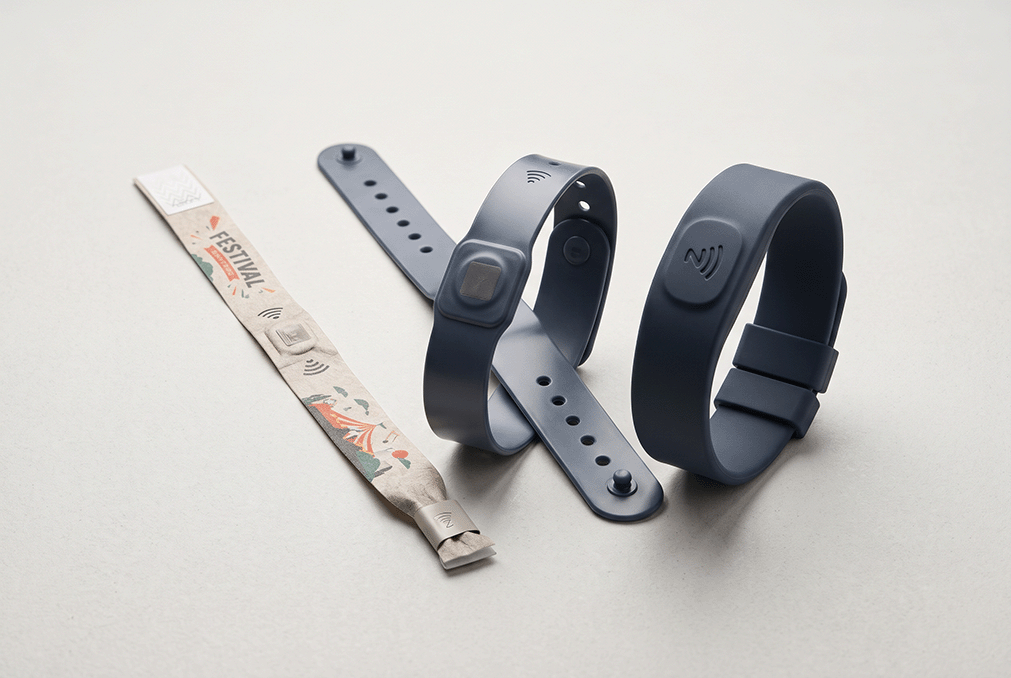
Material is a primary cost driver. NFC wristbands come in different materials at different price points: inexpensive paper or Tyvek for disposable bands, mid-range PVC or vinyl for durable reusable bands, and premium woven fabric or silicone for high-quality reusable bands. Disposable paper bands are the cheapest per unit, suited to high-volume single use, while silicone and fabric cost more but offer durability, reuse, and premium feel. The material you choose should match your application — paying for premium material you do not need wastes budget, while choosing flimsy material for a demanding application leads to failures. Material is often the largest single factor in the band's cost, so selecting the right material for your use and budget is the first cost decision. Understanding how material choice drives price helps you balance cost against the durability, reuse, and appearance your wristbands require, choosing the material that delivers what you need without overspending.
NFC chip type
The chip affects cost too. Different NFC chips have different capabilities and prices — basic chips like entry-level NTAG types are economical and sufficient for simple tap, access, or URL functions, while chips with more memory, security features, or specific capabilities cost more. For example, chips with strong security or larger memory suit applications needing them but add cost over basic chips. Choosing the right chip for your functional needs — neither overspending on capabilities you will not use nor underspecifying for what you require — optimizes cost. The chip must also be compatible with your system. Selecting an appropriate NFC chip that meets your access, payment, or interaction requirements without unnecessary premium features balances function and cost. The chip is a meaningful cost factor, so matching it to your actual needs ensures you pay for the capability you require. Understanding that chip choice affects price helps you specify NFC bands that do what you need economically, fitting the chip to the application rather than defaulting to the most or least capable option.
Order quantity and MOQ
Quantity strongly affects unit price through economies of scale. Larger orders have lower per-band costs, as fixed costs (setup, tooling, encoding configuration) spread across more units and production is more efficient at volume. Custom bands also have a minimum order quantity (MOQ) below which an order may not be accepted or carries a higher unit cost. Ordering in larger quantities, where your needs justify it, reduces the cost per band significantly. Conversely, small orders cost more per unit. Understanding the MOQ and how pricing tiers work helps you order at a quantity that achieves good unit economics. For large events needing many bands, the volume naturally lowers unit cost; for smaller needs, the MOQ and higher per-unit cost apply. Considering quantity and MOQ when ordering NFC wristbands lets you optimize cost, ordering enough to benefit from volume pricing while covering your needs, which is a key lever in the total cost of your wristband order.
Customization: color, printing, and branding
Customization adds to cost depending on what you want. Custom colors, printed logos, full-color graphics, and complex designs add production steps and cost over plain bands. Simple single-color bands with basic branding cost less than elaborate multi-color, fully printed designs. The level of customization — from a plain stock band to a fully branded custom one — affects the price. Deciding how much customization your application and brand goals justify helps balance cost; branding adds value for events but elaborate designs add cost. Choosing a level of customization appropriate to your needs and budget optimizes spend. While branding turns bands into marketing items, the cost scales with complexity, so selecting the customization that delivers your goals without unnecessary elaboration manages cost. Understanding that customization drives price helps you specify the branding you need cost-effectively, getting the visual impact and brand presence you want at a level of complexity your budget supports.
Closures and additional features
Closures and extra features affect cost. The closure type — basic adjustable, one-time locking, or specialized secure closures — carries different costs, with more sophisticated or secure closures adding to the price. Additional features like sequential numbering, barcodes alongside the NFC chip, or special finishes also add cost. Choosing closures and features appropriate to your security and operational needs, without unnecessary extras, manages cost. For ticketed events, a locking closure adds security and some cost; for reusable bands, adjustable closures suffice. Selecting the closure and features your application genuinely needs optimizes spend. These elements, while smaller factors than material or quantity, contribute to the total cost, so specifying them according to actual requirements rather than adding unneeded features helps control price. Understanding how closures and added features affect cost ensures you include what your wristbands need for security and function without paying for extras that do not serve your application.
Encoding and pre-programming services
Encoding services can add cost but save effort. If you have the manufacturer pre-encode bands with your data before shipping, this service may add to the per-band cost, but it saves you the significant time and effort of encoding bands yourself, especially at volume. Weigh the cost of pre-encoding against the value of receiving ready-to-use bands. For large events where on-site encoding would be burdensome, pre-encoding's cost is often justified by the time saved. For those with encoding capabilities and a need to re-encode reusable bands, self-encoding may be preferred. Considering whether to pay for pre-encoding depends on your quantity, timeline, and capabilities. The encoding approach affects both cost and your workload, so factoring this service into your cost comparison gives a complete picture. Understanding that pre-encoding adds cost but saves effort helps you decide whether it offers value for your wristband order based on your situation and resources.

Shipping and lead time
Shipping and lead time factor into total cost and planning. Shipping costs depend on quantity, weight, destination, and speed — expedited shipping costs more than standard. For international orders, shipping and any duties add to the landed cost. Lead time affects cost indirectly: rushed orders may incur premium charges, while ordering with adequate lead time allows standard production and shipping at normal cost. Planning ahead avoids rush fees and expensive expedited shipping. Factoring shipping and lead time into your total cost gives an accurate picture beyond the per-band price. Ordering early enough for standard shipping and production keeps these costs reasonable. Considering shipping and timing when budgeting for NFC wristbands ensures the total landed cost and timeline meet your needs, avoiding the premiums that last-minute orders and expedited shipping add to the base band cost.
Getting the best value
To get the best value, balance these factors against your actual needs. Choose the material that fits your application and budget, a chip that meets your functional needs without unnecessary premium features, a quantity that achieves good unit economics, customization appropriate to your goals, and closures and services your application requires. Order with adequate lead time for standard production and shipping. The goal is not the cheapest band but the best value — bands that meet your needs reliably at a sensible cost. Specifying smartly, informed by what drives cost, ensures you neither overspend on what you do not need nor underspecify for your requirements. As a manufacturer of NFC and RFID wristbands across materials, chips, and customization, our team can help you specify bands that balance cost and requirements for the best value. To get a quote and guidance on cost-effective NFC wristbands for your event, contact our team.
Frequently Asked Questions
What is the biggest cost factor for NFC wristbands?
Material is often the largest single factor — disposable paper or Tyvek bands are cheapest, mid-range PVC or vinyl cost more, and premium woven fabric or silicone cost the most. Order quantity is the other major driver, with larger orders lowering the per-band cost. Together, material and quantity usually shape most of the price.
How does quantity affect NFC wristband price?
Larger orders have lower unit costs because fixed costs like setup and tooling spread across more units and production is more efficient at volume. Custom bands also have a minimum order quantity, below which unit costs are higher. Ordering enough to benefit from volume pricing, where your needs justify it, significantly reduces cost per band.
Does the NFC chip affect the price?
Yes. Basic chips like entry-level NTAG types are economical and fine for simple tap, access, or URL functions, while chips with more memory or security features cost more. Choosing a chip that meets your functional needs without unnecessary premium capabilities — and that is compatible with your system — optimizes cost.
Is paying for pre-encoding worth it?
It depends. Pre-encoding adds to the per-band cost but saves the significant effort of encoding bands yourself, especially at volume — valuable for large events where on-site encoding would be burdensome. If you have encoding capabilities or need to re-encode reusable bands, self-encoding may be preferred. Weigh the cost against the time saved.
How can I get the best value on NFC wristbands?
Balance the cost factors against your actual needs: choose the right material and chip for your application without overspending, order a quantity that achieves good unit economics, customize appropriately, select only the closures and services you need, and order early to avoid rush and expedited shipping fees. Aim for best value, not just lowest price.
Get a clear, well-specified NFC wristband quote
We manufacture NFC and RFID wristbands across materials, chips, and customization — and help you specify for the best balance of cost and requirements for your event.
Request a quote Explore NFC tags