


We will cover the supply-chain trust problem, RFID's role capturing physical events, blockchain's immutable record, how they combine, applications in provenance and anti-counterfeiting, and adoption.
Key takeaways
- Supply chains struggle with trust, provenance, and tamper-proof records.
- RFID captures trusted data about physical goods at each point in the chain.
- Blockchain provides an immutable, shared record across partners.
- Together they enable provenance, anti-counterfeiting, and traceability.
The supply-chain trust problem
Modern supply chains span many partners — manufacturers, shippers, distributors, retailers — across regions, and trust between them is a challenge. Proving a product's origin and journey, verifying authenticity, and ensuring records have not been altered are difficult when data sits in separate systems controlled by different parties who may not fully trust one another. Counterfeiting, fraud, and disputes arise from this lack of shared, trustworthy information. The core problem is establishing trusted, tamper-proof information about physical goods that all partners can rely on. Addressing this requires both trustworthy data about the physical goods and a way to record it that all partners trust. Understanding the supply-chain trust problem — establishing reliable, shared, tamper-proof information across distrustful partners — frames why combining RFID and blockchain is compelling, where the challenge of trusted information about goods across a distributed supply chain motivates an approach pairing physical sensing with an immutable shared record.
RFID's role: capturing trusted physical events
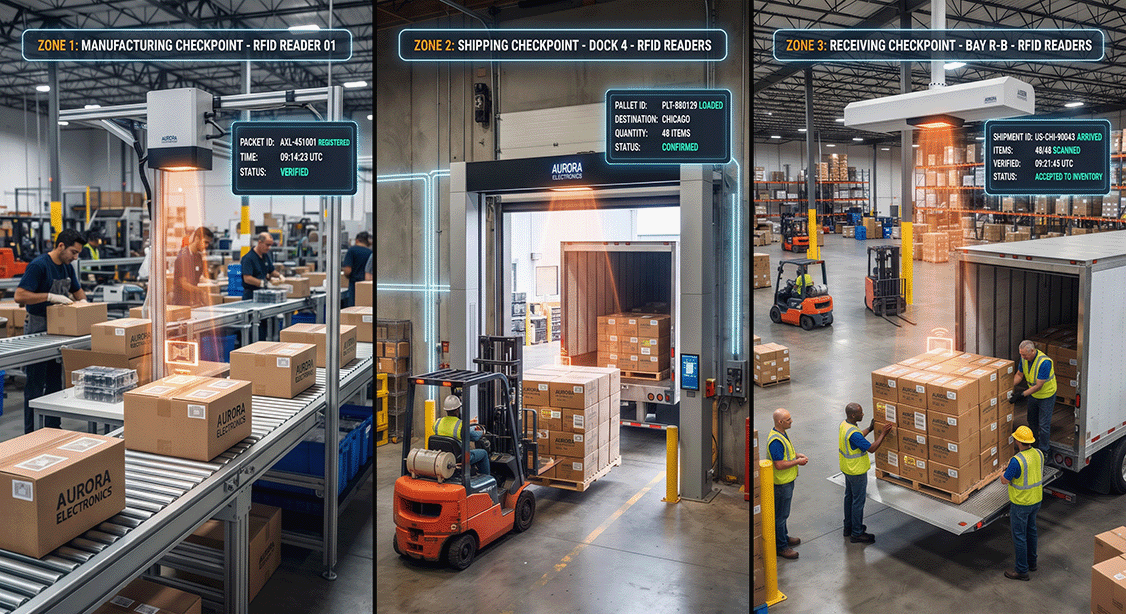
RFID addresses the physical side of the trust problem by capturing reliable data about goods at each point. As tagged goods move through the supply chain, RFID reads record what items are where and when — at manufacturing, shipping, receiving, and sale — generating trusted data about the physical journey. This automated, accurate capture is more reliable than manual records, providing a factual basis for what happened to the goods physically. RFID thus supplies the real-world events — the provenance and movement data — that need to be recorded trustworthily. Without reliable capture of physical events, there is nothing trustworthy to record; RFID provides this foundation. Understanding that RFID captures trusted data about physical goods at each supply-chain point explains its essential role, where the accurate, automated event capture RFID provides supplies the real-world information about goods' origin and journey that the system must record, forming the physical-world foundation on which supply-chain trust is built.
Blockchain's role: the immutable record
Blockchain addresses the recording side by providing an immutable, shared ledger. A blockchain is a distributed record that, once data is added, cannot be altered without detection, and that all participants can access and trust without relying on a single controlling authority. For supply chains, this means events recorded on the blockchain — such as the RFID-captured movements of goods — become a tamper-proof, shared history that all partners can trust. No single party can secretly alter the record, addressing the trust problem at the data level. Blockchain thus provides the trustworthy, shared, tamper-proof recording that the physical event data needs. Understanding that blockchain provides an immutable, shared record that all partners trust explains its complementary role, where the tamper-proof distributed ledger blockchain offers gives the supply chain a way to record the physical events RFID captures such that all partners can trust the record without a central authority, solving the data-trust side of the challenge.
How they combine for traceability
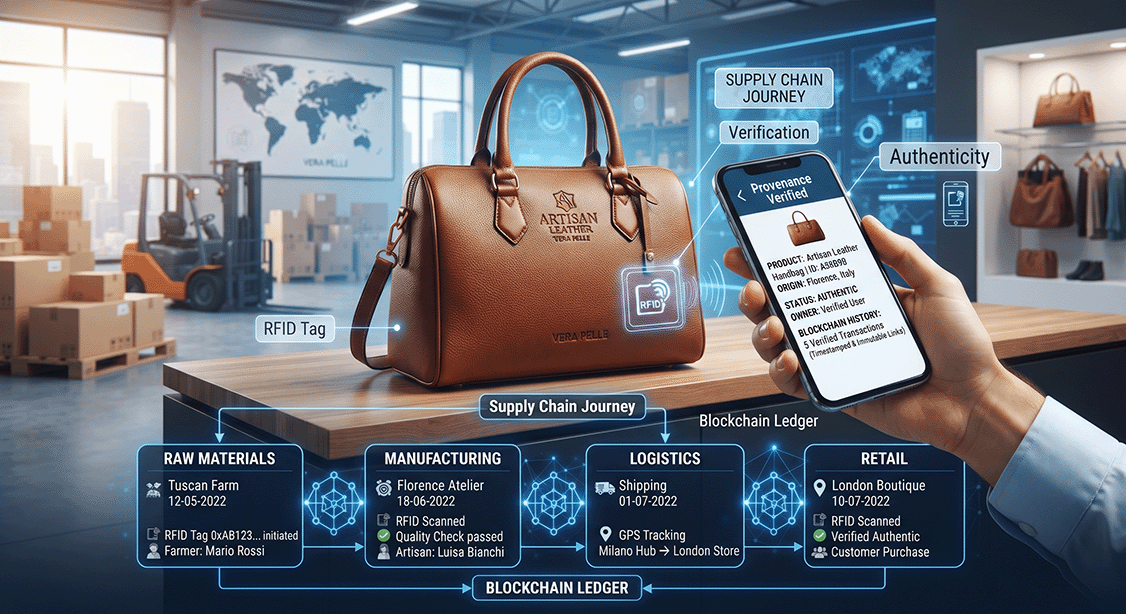
Together, RFID and blockchain create end-to-end traceability with trust. RFID captures the physical events — goods moving through the chain — and these events are recorded on the blockchain, creating an immutable, shared history of each product's journey that all partners can trust. The result is traceability: the ability to trace a product's complete journey from origin to destination, backed by trustworthy physical data and a tamper-proof record. This combination addresses both sides of the trust problem — reliable physical data (RFID) and trustworthy recording (blockchain) — achieving what neither does alone. The synergy is that RFID provides the trusted physical events and blockchain provides the trusted record of them. Understanding that RFID's event capture combined with blockchain's immutable record enables trusted end-to-end traceability shows the power of the combination, where pairing the physical sensing of RFID with the tamper-proof recording of blockchain delivers the supply-chain traceability and trust that distributed supply chains need but struggle to achieve with either technology alone.
Provenance and anti-counterfeiting
Key applications of combined RFID and blockchain are provenance and anti-counterfeiting. For provenance, the combination proves a product's origin and journey — valuable for products where authenticity, ethical sourcing, or quality assurance matter, such as luxury goods, food, or pharmaceuticals — by providing a trustworthy record of where the product came from and how it traveled. For anti-counterfeiting, the ability to verify a genuine product against its trusted record helps distinguish authentic goods from fakes, since counterfeits lack the legitimate RFID identity and blockchain history. These applications address significant supply-chain problems — proving authenticity and origin — that the combination is well suited to solve. Understanding that RFID and blockchain enable provenance and anti-counterfeiting shows their practical value, where the trusted origin-and-journey record the combination provides helps prove products are genuine and ethically sourced, addressing the counterfeiting and provenance challenges that matter for many products and supply chains.
Adopting RFID for blockchain-enabled supply chains
Adopting a blockchain-enabled, RFID-based supply-chain solution starts with the physical foundation: tagging goods with reliable RFID and capturing their events. The RFID layer — appropriate tags and reading infrastructure — provides the trusted physical data that the blockchain records. Building on a solid RFID foundation ensures the data feeding the blockchain is accurate, which is essential since the record is only as trustworthy as the data captured. A capable RFID manufacturer provides the tags and guidance for this foundation. While blockchain integration involves additional systems, the RFID layer is fundamental, supplying the trusted physical events. As a manufacturer of RFID tags for supply-chain applications, our team produces the tags that provide the reliable physical-world data for traceability solutions. To build the RFID foundation for a traceable, secure supply chain, contact our team for the tags that capture trusted data across your supply chain.
Frequently Asked Questions
How do blockchain and RFID work together in supply chains?
RFID captures trusted data about physical goods — what items are where and when — at each supply-chain point, and these events are recorded on a blockchain, an immutable shared ledger all partners trust. Together they provide reliable physical data and tamper-proof recording, enabling trusted end-to-end traceability.
Why combine RFID with blockchain?
Blockchain provides a tamper-proof shared record but cannot observe the physical world, while RFID captures reliable physical events but needs trustworthy recording. Combining them addresses both sides of supply-chain trust — reliable physical data from RFID and an immutable shared record from blockchain — achieving what neither does alone.
How does this combination fight counterfeiting?
The combination lets a genuine product be verified against its trusted record — its legitimate RFID identity matched to an immutable blockchain history of origin and journey. Counterfeits lack this legitimate identity and history, so the trusted provenance record helps distinguish authentic goods from fakes.
What is supply-chain provenance?
Provenance is the proven origin and journey of a product. Combining RFID-captured movement data with a blockchain record creates a trustworthy history of where a product came from and how it traveled, valuable for products where authenticity, ethical sourcing, or quality assurance matter, such as luxury goods, food, and pharmaceuticals.
What does RFID contribute to a blockchain supply chain?
RFID provides the physical-world foundation — capturing accurate, automated data about goods at each point, which the blockchain records. Since the record is only as trustworthy as the data captured, the reliable RFID layer is essential, supplying the trusted physical events that make the blockchain record meaningful.
Build the RFID foundation for supply-chain trust
As a manufacturer of RFID tags for supply-chain applications, we produce the tags that capture trusted physical data — the reliable foundation for traceable, blockchain-enabled supply chains.
Discuss your supply chain Explore RFID tags