


We will cover what cashless wristbands are, how top-up payment works, faster entry, quicker service, less cash handling, spend data, refunds and reconciliation, and choosing.
Key takeaways
- Cashless wristbands link a wrist band to a prepaid, top-up balance.
- Guests pay with a tap, speeding service at bars and points of sale.
- Less cash handling improves speed, security, and reconciliation.
- Digital transactions generate useful spend data and easier refunds.
What RFID cashless wristbands are
RFID cashless wristbands are bands with an embedded chip linked to a guest's prepaid balance or payment account, used to pay for purchases with a tap. The band — paper, silicone, fabric, or PVC depending on the event — carries a chip whose unique ID is associated with the guest's funds in the system. To pay, the guest taps the band at a point of sale, and the amount is deducted from their balance. Guests load funds onto their band (top-up) before or during the event, then spend by tapping. The same band can also handle entry and access. Cashless wristbands thus turn the wrist into a payment method, removing the need for cash or cards at the event. Understanding that cashless bands connect a wearable credential to a prepaid balance, enabling tap-to-pay, is the basis for seeing how they streamline the spending and entry that define the event experience, replacing slow cash transactions with fast contactless taps throughout the venue.
How top-up cashless payment works
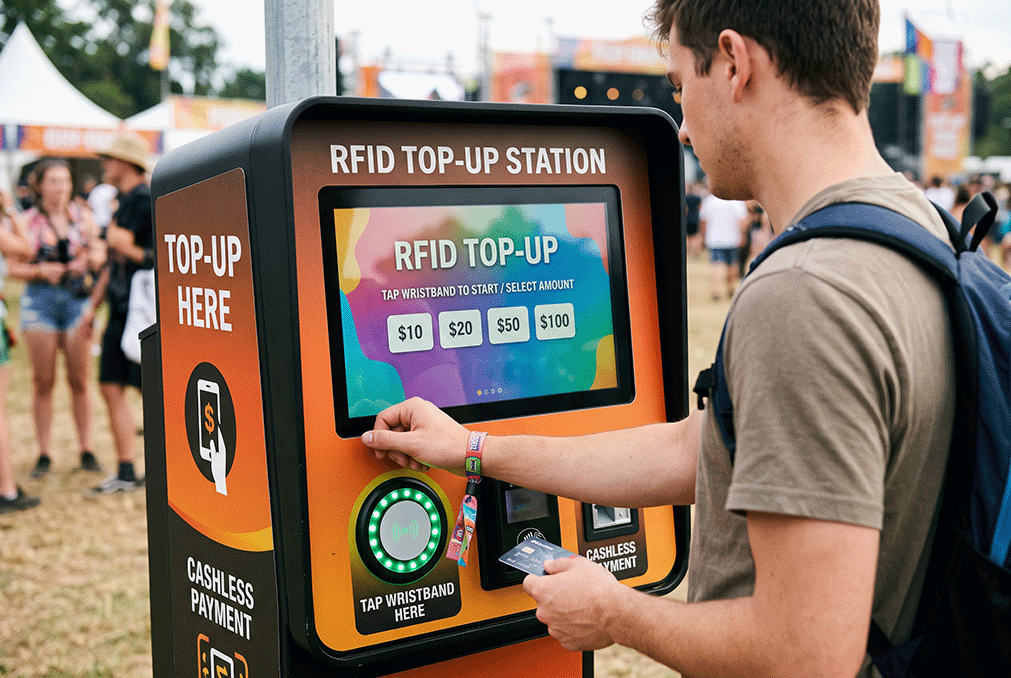
The model behind cashless wristbands is top-up and tap. Guests load funds onto their band — online before the event, at top-up stations or staff on-site, or via an app — creating a prepaid balance linked to the band's chip. When they buy something, they tap the band at the point of sale, the system identifies the band and deducts the amount, and the transaction completes in seconds. Some systems link the band to a registered card or account for automatic top-up or post-event billing instead of prepaid balances. The guest sees a fast, simple payment; the system handles the balance and transaction behind the scenes. This top-up-and-tap model is what makes cashless spending fast and frictionless. Understanding how funds are loaded and deducted clarifies the mechanics: the band is a key to the guest's balance, and tapping spends it, enabling the rapid transactions that streamline points of sale across the event without cash changing hands.
Faster entry
Beyond payment, cashless wristbands streamline entry. The same band that holds the guest's balance serves as their ticket and access credential, so entry is a tap that validates the band instantly — faster than checking tickets or scanning phones. This speeds entry at gates and access points, reducing queues. Combining entry and payment on one band means guests onboard once (getting and topping up the band) and then use it for everything, simplifying their experience. Faster entry improves flow and first impressions. For events, consolidating access and payment on the cashless band streamlines both, removing separate ticket-checking and payment processes. The faster entry that cashless wristbands enable, by serving as the access credential alongside the payment method, contributes to smoother operations, ensuring guests move quickly through entry and then spend easily inside, all with the same band — a unified credential that streamlines the whole guest journey from gate to point of sale.
Quicker service at bars and points of sale
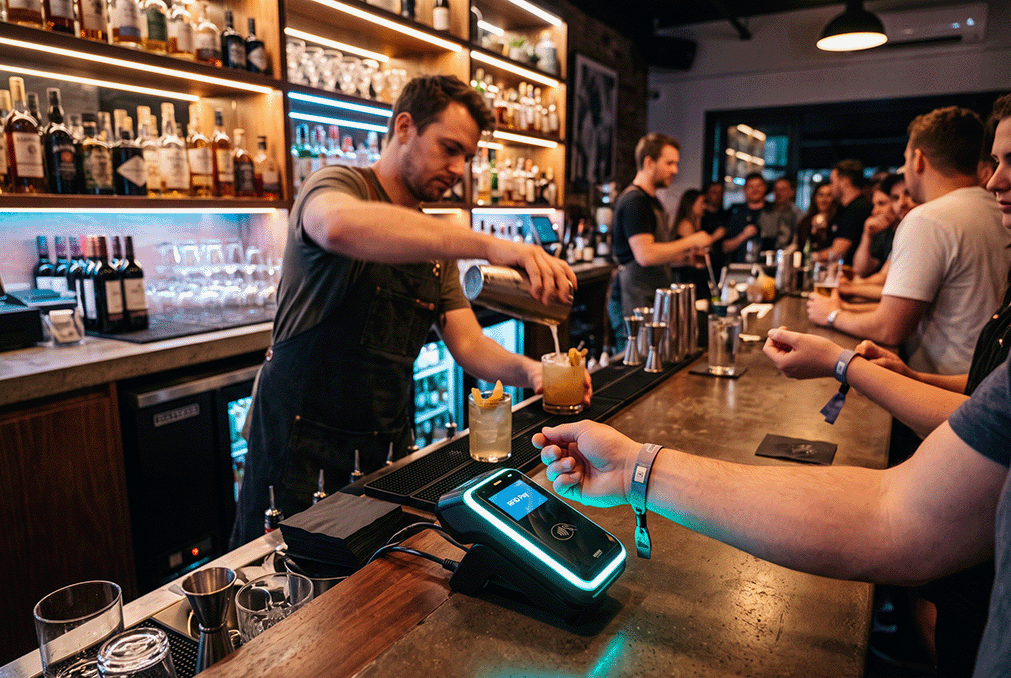
The biggest payment benefit is faster service at bars and points of sale — the classic event bottleneck. Cash transactions are slow: counting money, making change, handling notes. A tap-to-pay cashless band completes a transaction in seconds, dramatically speeding service at busy bars and vendors. Faster transactions mean shorter queues, more guests served, and more sales in the same time. At a packed festival bar, the difference between cash and tap-to-pay is substantial for throughput. Guests get served faster and spend more easily, while operators move more volume. This acceleration of point-of-sale service is a primary way cashless wristbands streamline events, turning slow cash lines into fast tap transactions. The quicker service that cashless bands enable at bars and vendors directly improves both the guest experience and revenue, addressing the payment bottleneck that limits how many guests an event can serve, which is a core reason events adopt cashless wristband systems.
Less cash handling and better security
Removing cash brings operational and security benefits. With cashless spending, vendors handle little or no physical cash, reducing the time spent counting and making change, the security risk of holding cash, and the burden of reconciling cash across many points of sale. Less cash on-site means lower theft risk and fewer cash-management logistics. Transactions are recorded digitally, making reconciliation accurate and straightforward rather than tallying cash drawers. For operators, reduced cash handling improves speed, security, and financial control. Staff focus on serving rather than managing money. The reduction in cash handling that cashless wristbands enable is a significant benefit, removing much of the friction, risk, and administrative burden cash creates at events. This contributes to smoother, faster, more secure operations and cleaner reconciliation, complementing the service-speed benefits and making the event easier and safer to run, which is a key advantage of cashless systems for operators managing high-volume events.
Spend data and insights
A capability cash never offered is data. Because cashless transactions are digital, the system records spending — what guests buy, when, where, and how much — generating insights operators can use. This data reveals popular products, peak times, and spending patterns, informing decisions on stock, staffing, pricing, and layout for the current and future events. Real-time data can guide operational adjustments during the event. Used appropriately and with respect for privacy, this spending data is valuable for understanding and improving the event. Cash transactions leave no such record, so the data capability is a distinct advantage of cashless systems. The spend data and insights that cashless wristbands generate add analytical value beyond the immediate efficiency, helping operators make informed decisions about their event and vendors. This data dimension, enabled by digitizing spending through the band, turns the payment system into a source of business intelligence about how guests actually spend at the event.
Refunds, reconciliation, and choosing
Cashless systems also handle refunds and reconciliation cleanly. Unspent prepaid balances can be refunded to guests after the event through the system, and the digital record makes financial reconciliation accurate and efficient. To choose the right cashless band, match the chip and system to your payment platform, select the band material (paper for single-use events, silicone or fabric for reuse or premium) for your event, ensure secure closures and reliable reads, and plan the top-up and refund processes. Working through these ensures a smooth cashless deployment. As a manufacturer of RFID wristbands including silicone and disposable bands for cashless systems, our team supplies bands with the right chip and pre-encoding for your platform. To get RFID cashless wristbands that streamline entry and spending, contact our team with your event and payment system details.
Frequently Asked Questions
How do RFID cashless wristbands work?
The band's chip is linked to a guest's prepaid balance. Guests load funds (top-up) online, at stations, or via an app, then pay by tapping the band at a point of sale, which deducts the amount in seconds. Some systems link to a registered card for auto top-up or post-event billing instead of prepaid balances.
How do they speed up service?
A tap-to-pay transaction completes in seconds, versus the slow process of counting cash and making change. This dramatically speeds service at busy bars and vendors — the classic event bottleneck — meaning shorter queues, more guests served, and more sales in the same time, improving both experience and revenue.
Do cashless wristbands reduce cash handling?
Yes. Vendors handle little or no physical cash, reducing time counting and making change, the security risk of holding cash, and the burden of reconciling cash across points of sale. Transactions are recorded digitally, making reconciliation accurate and straightforward, which improves speed, security, and financial control for operators.
What data do cashless systems provide?
Because transactions are digital, the system records what guests buy, when, where, and how much, revealing popular products, peak times, and spending patterns. Used appropriately and with respect for privacy, this informs decisions on stock, staffing, pricing, and layout — insights cash transactions cannot provide — for the current and future events.
Can guests get refunds on unspent balances?
Yes. Cashless systems can refund unspent prepaid balances to guests after the event, and the digital transaction record makes reconciliation accurate and efficient. The refund and reconciliation processes should be planned as part of the deployment, and the band and chip chosen to work with your payment platform's capabilities.
Streamline entry and spending with RFID cashless wristbands
We supply RFID and NFC wristbands for cashless systems — paper, silicone, or fabric — with the right chip and pre-encoding to power fast tap-to-pay at your event.
Discuss cashless for your event Explore RFID wristbands