


We will cover identifying costs, quantifying benefits, building the calculation, payback period, intangible benefits, and making the business case.
Key takeaways
- RFID ROI weighs the full costs against the often-underestimated benefits.
- Costs include tags, readers, software, integration, and ongoing expenses.
- Benefits span labor savings, inventory accuracy, loss reduction, and efficiency.
- Payback period and intangible benefits complete the business case.
Identifying the full costs
An honest ROI starts with identifying all the costs, not just the obvious ones. The costs of an RFID deployment include the tags — an ongoing cost scaled to the volume of items tagged — and the hardware, including readers, antennas, and supporting equipment. Software and integration costs cover the systems to manage RFID data and connect to existing systems. Implementation costs include installation, configuration, and any process changes. Ongoing costs include continued tag purchases, maintenance, and support. Capturing all these costs gives a true picture of the investment, avoiding the mistake of underestimating by considering only hardware or only tags. A complete cost accounting is essential to a credible ROI. For the calculation to be honest and useful, identifying the full range of costs — tags, hardware, software, integration, implementation, and ongoing expenses — ensures the investment side reflects reality. Understanding and totaling all the costs of the RFID deployment provides the foundation for an accurate ROI calculation, against which the benefits are weighed to determine whether the investment pays off.
Quantifying labor savings
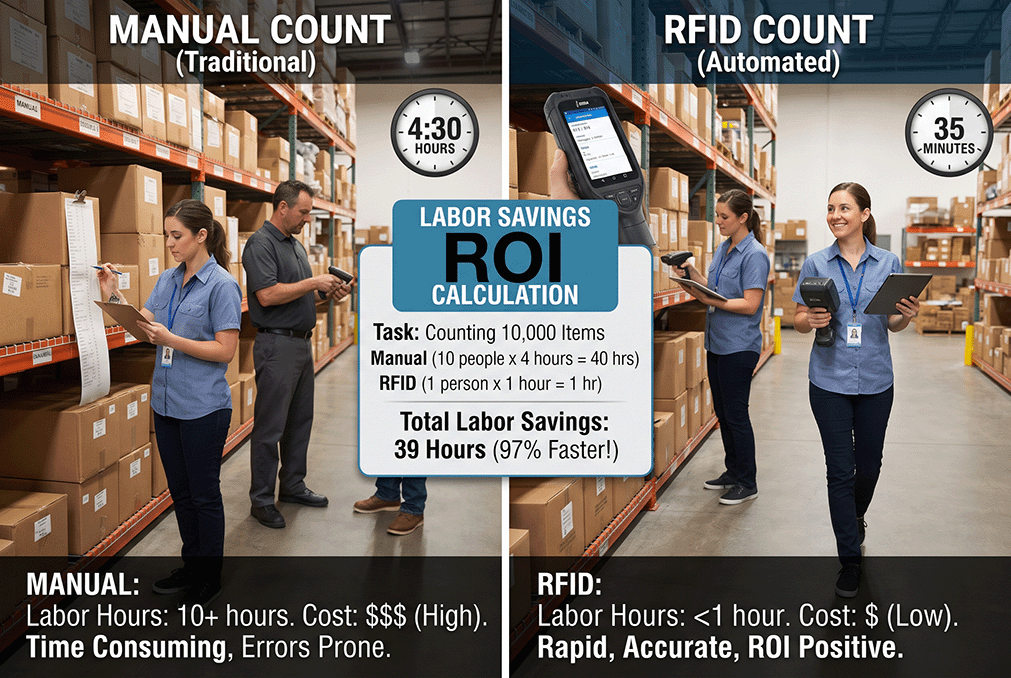
Labor savings are often a major RFID benefit and a key part of ROI. RFID automates tasks that previously required manual labor — counting inventory, scanning items individually, searching for assets, and recording movements — saving the time and cost of that labor. Quantifying these savings means estimating the labor time RFID eliminates or reduces and valuing it. For example, if RFID reduces the time to count inventory dramatically, the labor saved across all counts is a quantifiable benefit. Similarly, time saved finding assets, processing items, or recording data contributes. These labor savings often represent a substantial recurring benefit that accumulates over time. Quantifying them requires understanding the current labor involved in tasks RFID will automate and estimating the reduction. For many deployments, labor savings are among the largest and most readily quantified benefits. Understanding and quantifying the labor RFID saves — by automating counting, scanning, searching, and recording — captures a major recurring benefit for the ROI calculation, often a primary driver of the return that justifies the investment.
Quantifying inventory accuracy benefits
Inventory accuracy improvements deliver benefits that should be quantified in the ROI. RFID dramatically improves inventory accuracy, and this accuracy translates into financial benefits: reduced stockouts that cost sales, reduced overstock that ties up capital, better availability that supports revenue, and the efficiency of accurate stock data. Quantifying these benefits means estimating the value of improved accuracy — the sales recovered from fewer stockouts, the capital freed from reduced overstock, and the operational gains. For retail and inventory-intensive operations, the value of moving from inaccurate to highly accurate inventory can be substantial, affecting sales, capital, and efficiency. While quantifying these benefits requires estimation, the impact of inventory accuracy on the business is real and often significant. Understanding and estimating the financial benefits of improved inventory accuracy — recovered sales, freed capital, operational efficiency — captures an important RFID benefit for the ROI. For inventory-intensive businesses, the accuracy benefits RFID delivers contribute meaningfully to the return, making their quantification an important part of a complete ROI analysis.
Quantifying loss reduction
Loss reduction is another quantifiable RFID benefit. RFID helps reduce losses from theft, shrinkage, misplacement, and errors by providing visibility and accountability. The value of reduced losses — fewer stolen or lost items, reduced shrinkage, fewer costly errors — is a direct financial benefit. Quantifying it means estimating the current losses RFID will reduce and the expected reduction. For operations with significant shrinkage or loss, this benefit can be substantial, directly improving the bottom line. The visibility RFID provides into where items are and what is happening deters and reduces the losses that erode margins. Estimating the loss reduction RFID enables captures this benefit for the ROI. For businesses where theft, shrinkage, or misplacement are meaningful costs, the loss-reduction benefit contributes to the return. Understanding and quantifying the losses RFID reduces — theft, shrinkage, misplacement, errors — captures a direct financial benefit for the ROI calculation, which for loss-prone operations can be a significant component of the return that justifies investing in RFID.
Building the ROI calculation
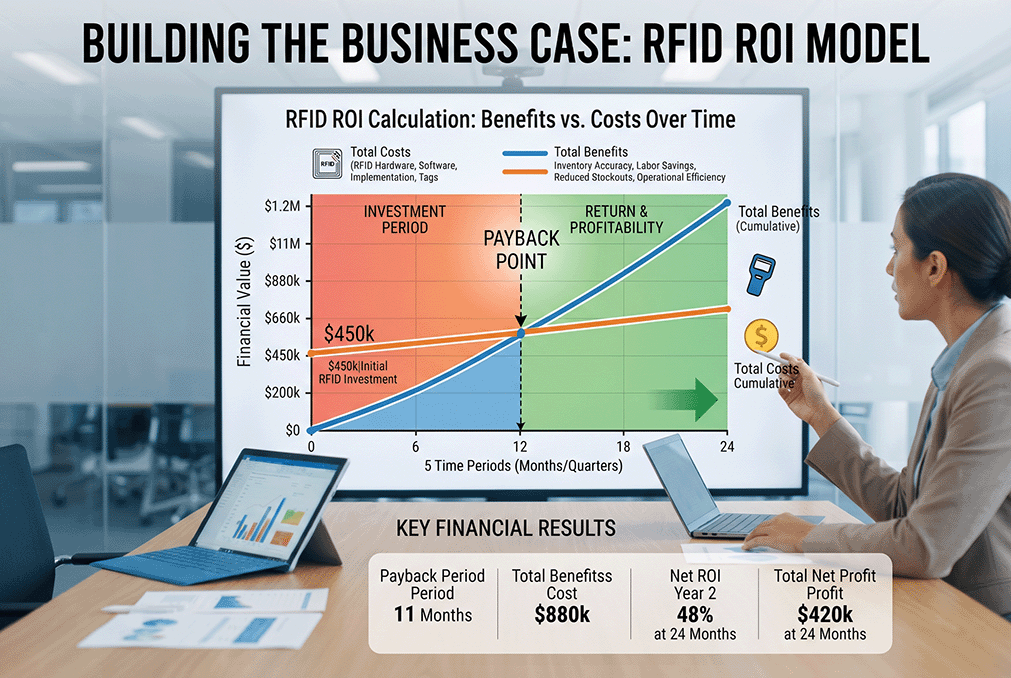
The ROI calculation brings costs and benefits together into a result. With the full costs and quantified benefits identified, the calculation compares them — typically expressing the return relative to the investment and over time. A common approach calculates the net benefit (benefits minus costs) and the return as a percentage of the investment, along with how long until the benefits repay the costs. The calculation should consider the timeframe, since benefits accumulate while some costs are upfront and others ongoing. Building the calculation transparently, with clear assumptions for costs and benefits, produces a credible result stakeholders can evaluate. Conservative assumptions strengthen credibility. The calculation reveals whether and how strongly the investment pays off. Bringing the full costs and quantified benefits together into a clear ROI calculation, with transparent assumptions and an appropriate timeframe, produces the result that informs the investment decision. Understanding how to build the ROI calculation — comparing total benefits to total costs over time — turns the cost and benefit estimates into the financial answer about whether RFID makes sense for the business.
Payback period and timeframe
The payback period — how long until benefits repay the investment — is a key ROI metric. Because RFID involves upfront costs and ongoing benefits, the payback period shows when the deployment becomes net positive. A shorter payback period indicates a faster return and lower risk, while a longer one requires more patience but may still be worthwhile if benefits continue. Understanding the payback period helps assess the investment's attractiveness and risk. The timeframe also matters because benefits accumulate over time, so the ROI over a multi-year period may be compelling even if the first year is dominated by upfront costs. Considering both the payback period and the longer-term return gives a complete picture. For stakeholders, the payback period is often a key consideration in approving investment. Understanding the payback period and the timeframe over which RFID pays off completes the financial picture, showing when the investment becomes net positive and the return it delivers over time. This temporal dimension is essential to evaluating the investment realistically, since RFID's benefits accumulate to repay the upfront costs over the deployment's life.
Intangible benefits and the business case
Intangible benefits complete the business case beyond the quantified ROI. Some RFID benefits are real but hard to quantify precisely: improved customer experience, better decision-making from data, competitive advantage, scalability, and strategic positioning. While these may not appear in the ROI number, they add to the case for investment and should be noted. A complete business case presents the quantified ROI alongside these intangible benefits, giving stakeholders the full value picture. The quantified ROI provides the financial justification, while the intangible benefits add strategic value. Together they make a compelling case where the investment is sound. As a manufacturer helping businesses deploy RFID, our team can discuss the costs and the benefits realistically, supporting your business case. Presenting the quantified ROI together with the intangible benefits provides the complete business case for RFID investment. Understanding both the quantifiable return and the intangible strategic benefits ensures the business case captures RFID's full value, supporting an informed decision. To discuss the costs and benefits of RFID for your business and build your case, contact our team for realistic guidance.
Frequently Asked Questions
How do I calculate RFID ROI?
Identify all costs (tags, hardware, software, integration, implementation, ongoing expenses), quantify the benefits (labor savings, inventory accuracy, loss reduction, efficiency), then compare them over an appropriate timeframe — typically calculating net benefit and return as a percentage of investment, plus the payback period.
What are the main costs of an RFID deployment?
Tags (an ongoing cost scaled to tagged items), hardware (readers, antennas, equipment), software and integration to manage RFID data and connect to existing systems, implementation (installation, configuration, process changes), and ongoing costs (continued tag purchases, maintenance, support). Capturing all gives a true investment picture.
What benefits should I include in RFID ROI?
Labor savings from automating counting, scanning, searching, and recording; inventory accuracy benefits like recovered sales and freed capital; loss reduction from less theft, shrinkage, and misplacement; and efficiency gains. These quantifiable benefits, often underestimated, accumulate over time to repay the investment.
What is a good RFID payback period?
A shorter payback period indicates a faster return and lower risk, while a longer one may still be worthwhile if benefits continue. The right expectation depends on the deployment, but understanding when benefits repay the upfront investment, and the longer-term return, helps assess the investment's attractiveness.
Should intangible benefits be in the business case?
Yes. Benefits like improved customer experience, better data-driven decisions, competitive advantage, and scalability are real but hard to quantify precisely. While they may not appear in the ROI number, presenting them alongside the quantified return gives stakeholders the full value picture and strengthens the case.
Build your RFID business case
We help businesses understand the real costs and benefits of RFID, supporting an honest ROI calculation and a business case grounded in your operations and goals.
Discuss your business case Explore our solutions