


We will cover handling read volumes, filtering and processing, integration with business systems, data quality, storage and architecture, security, and turning data into insight.
Key takeaways
- At scale, RFID generates high volumes of raw read data that must be managed.
- Filtering and processing turn noisy raw reads into meaningful events.
- Integration with business systems makes RFID data actionable.
- Data quality, sound architecture, and security underpin large deployments.
Handling high read volumes
Scale brings high read volumes that the system must handle. In large deployments, many readers generate continuous reads as tagged items are detected, producing a high volume of raw data that the infrastructure must capture and process without being overwhelmed. Handling this volume requires infrastructure designed for the scale — capable of capturing the read stream reliably and processing it efficiently. Underestimating the data volume leads to systems that cannot keep up, losing data or bogging down. Designing for the actual read volume the deployment will generate ensures the system can handle the data load. For large-scale RFID, the ability to handle high read volumes is foundational, since the data must be captured and processed reliably for the system to function. Building infrastructure that can capture and process the high volume of reads a large deployment generates ensures the data flows reliably into the systems that use it, making volume handling a fundamental requirement for large-scale RFID data management that the architecture must be designed to meet from the outset.
Filtering and processing raw reads
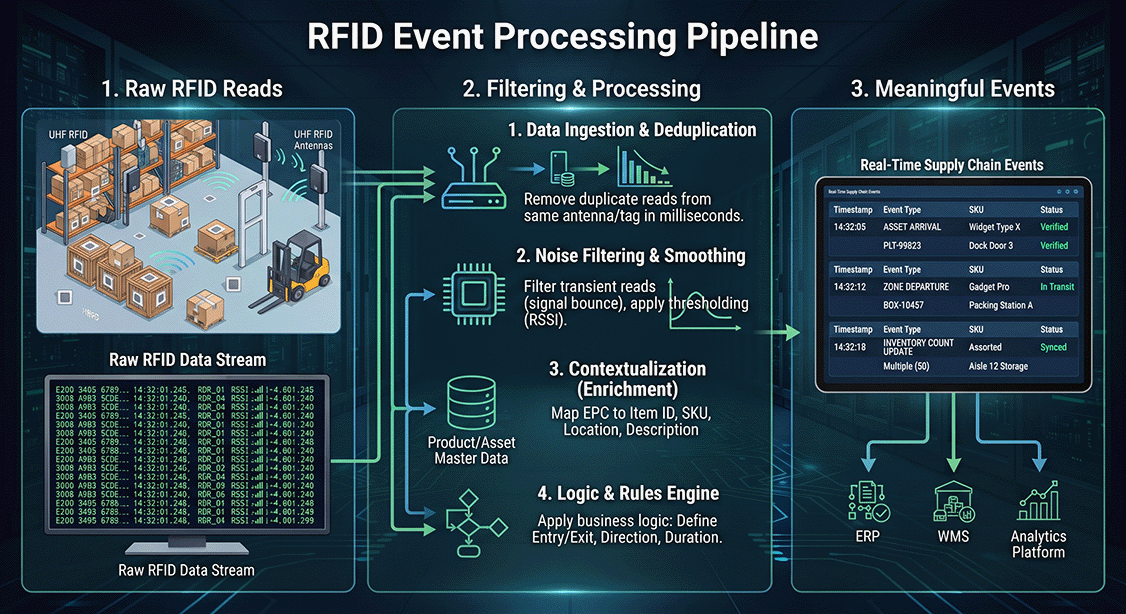
Raw reads are noisy and must be filtered and processed into meaningful information. A reader may read the same tag many times, read tags not relevant to a particular event, or generate reads that need interpretation to become useful. Filtering removes redundant and irrelevant reads, and processing interprets the reads into meaningful events — an item arriving, moving, or leaving — rather than a stream of raw detections. This filtering and processing turns the noisy raw read data into the clean, meaningful events that business systems and decisions need. Without it, systems are overwhelmed by raw, redundant, ambiguous data. The filtering and processing layer is essential to making RFID data useful, distilling the read stream into significant events. For large deployments, robust filtering and processing is critical, transforming the high-volume raw read data into the meaningful, actionable events that drive value. By filtering out noise and processing raw reads into significant events, the system turns the firehose of detections into the clean information that business systems can use, making this processing layer a crucial component of effective large-scale RFID data management.
Integration with business systems
Integration makes RFID data actionable by connecting it to the systems that use it. The processed RFID events must flow into the business systems — inventory management, warehouse management, enterprise resource planning, and analytics — where they inform operations and decisions. This integration is what makes RFID data useful, connecting the physical-object visibility to the systems that manage the business. Without integration, RFID data sits isolated, unable to drive the operations it should inform. Designing the integration so RFID events feed the relevant systems reliably ensures the data drives value. For large deployments, robust integration with business systems is essential, as the value of RFID data is realized when it informs the systems and decisions that run the operation. The integration of processed RFID data into business systems is what turns the data into operational value, connecting the visibility RFID provides to the management systems that act on it. By ensuring processed RFID events flow reliably into inventory, warehouse, enterprise, and analytics systems, integration makes the data actionable, realizing the operational value that justifies the RFID deployment and making integration a central concern of large-scale data management.
Ensuring data quality
Data quality underpins the value of RFID data, as poor-quality data leads to poor decisions. Ensuring the data is accurate, complete, and reliable requires attention to read accuracy, handling of missed or erroneous reads, and validation that the data reflects reality. Quality issues — missed reads, errors, inconsistencies — undermine the trust and value of the data. Monitoring and maintaining data quality ensures the information driving decisions is reliable. For large deployments, where data drives significant operations, data quality is critical, since decisions based on flawed data can be costly. Implementing practices to ensure and monitor data quality — validation, error handling, accuracy monitoring — maintains the reliability that makes the data valuable. By ensuring the RFID data is accurate, complete, and reliable through attention to quality, large deployments maintain the trust in the data that effective decision-making requires. The data quality practices that keep RFID information accurate and reliable are essential to realizing its value, since the decisions and operations the data drives are only as good as the data itself, making data quality a foundational concern for large-scale RFID deployments.

Storage, architecture, and security
Sound architecture and security support large-scale data management. The data must be stored appropriately, with architecture designed for the volume and use — capturing, processing, storing, and serving the data efficiently and reliably at scale. The architecture should be scalable to handle growth and robust to ensure reliability. Security is essential, protecting the RFID data, which may be sensitive or business-critical, through appropriate access controls, protection, and security practices. For large deployments, the data architecture and security are foundational, ensuring the data is managed reliably and protected appropriately. Designing a scalable, robust architecture and implementing sound security ensures the large-scale data management functions dependably and securely. The architecture and security underpinning large-scale RFID data management ensure the data is handled reliably, scales with the deployment, and is protected appropriately. By building a sound, scalable architecture and implementing proper security, large deployments ensure their RFID data is managed and protected effectively, providing the reliable, secure foundation that large-scale data management requires for the data driving significant operations.
Turning data into actionable insight
The ultimate goal is turning RFID data into actionable insight that drives value. Beyond capturing and managing the data, analyzing it provides insight — into operations, efficiency, patterns, and opportunities — that informs decisions and improvements. The analytics applied to RFID data turn it from a record of events into intelligence that drives better operations. This is where the value of all the data management is realized: in the insight and decisions the data enables. For large deployments, the analytics and insight derived from the data justify the investment in capturing and managing it. Applying analytics to turn the managed RFID data into actionable insight is the culmination of effective data management, delivering the operational intelligence that drives value. As a manufacturer of RFID products supporting large-scale deployments, our team provides the reliable, consistently encoded tags that produce quality data at the source, the foundation of effective data management. To source RFID products for large-scale deployments and discuss the tags that underpin quality data, contact our team for guidance on products suited to your scale.
Frequently Asked Questions
Why is data management important for large RFID deployments?
At scale, RFID generates an enormous volume of raw read data, and the value lies not in the raw reads but in filtering, processing, integrating, and analyzing them into actionable insight. Deployments that manage data poorly drown in noise and fail to realize value, while those that manage it well gain operational intelligence.
How do you handle the volume of RFID reads at scale?
By designing infrastructure for the actual read volume the deployment will generate — capable of capturing the continuous read stream reliably and processing it efficiently without being overwhelmed. Underestimating volume leads to systems that cannot keep up, so the architecture must be built for the scale from the outset.
What is RFID data filtering and why is it needed?
Raw reads are noisy — the same tag may be read many times, irrelevant tags may be read, and reads need interpretation. Filtering removes redundant and irrelevant reads, and processing interprets them into meaningful events like an item arriving or leaving, turning the noisy stream into clean, actionable information.
How does RFID data become actionable?
Through integration with business systems — inventory, warehouse, enterprise, and analytics systems — where processed RFID events inform operations and decisions, and through analytics that turn the data into insight. Integration connects the physical-object visibility to the systems that run the business, realizing the data's value.
How does tag quality affect data management?
Tag quality affects data quality at the source. Reliable, consistently encoded tags produce accurate, dependable reads, while poor tags cause missed or erroneous reads that undermine data quality. Since decisions are only as good as the data, quality tags producing quality data are the foundation of effective large-scale data management.
Power large-scale deployments with quality data at the source
We provide reliable, consistently encoded RFID tags that produce the quality data effective large-scale management depends on — the foundation beneath your filtering, integration, and analytics.
Discuss your large deployment Explore our products