


We will cover defining goals, choosing frequency, selecting tags and readers, planning infrastructure and software, piloting, and scaling the system.
Key takeaways
- Start with clear business goals — what you want RFID to achieve.
- Choose the frequency, tags, and readers that fit your application.
- Plan infrastructure and software integration as part of the system.
- Pilot before scaling to validate the design and refine it.
Step 1: Define your goals and requirements
Design starts with clearly defining what you want RFID to achieve. Identify the business problem you are solving — tracking inventory, managing assets, controlling access, improving a process — and the specific outcomes you need. Define the requirements: what must be tracked, where, with what accuracy, and integrated with what systems. Clear goals and requirements guide every subsequent decision, ensuring the system you design addresses your actual needs. Without this clarity, design choices lack direction and the system may not deliver value. Understanding precisely what you want to accomplish, and the requirements that follow, is the essential foundation. Taking time to define goals and requirements — the problem, the outcomes, what must be tracked and how — ensures the design serves your business purpose. This upfront clarity about what the RFID system must achieve directs all the technical choices that follow, making goal definition the critical first step in designing a system that genuinely solves your business problem rather than a technically interesting deployment that misses the mark.
Step 2: Choose the right frequency
Frequency selection is a foundational technical choice shaped by your application. RFID operates at low frequency (LF), high frequency (HF, including NFC), and ultra-high frequency (UHF), each with different characteristics. UHF offers longer range and fast bulk reading, suiting inventory and supply-chain applications. HF and NFC offer short range suited to access, payments, and engagement. LF suits specific uses like animal tracking. The right frequency depends on your range needs, reading requirements, and application. Choosing the appropriate frequency band is fundamental, as it determines the capabilities available and the tags and readers you will use. Matching the frequency to your application — long-range bulk reading versus short-range secure interaction — ensures the system's fundamental capabilities fit your needs. The frequency choice, driven by your goals and requirements, sets the technical foundation for the tags and readers that follow, making it a key early decision that shapes the entire system's capabilities and suitability for your particular application.

Step 3: Select tags for your application
Tag selection matches the tags to what you are tracking and the conditions they face. Choose tags suited to the items — appropriate form factor, size, and attachment — and the environment, including any challenges like metal surfaces, moisture, or harsh conditions. Select the chip providing the memory and features your application needs. The tags must read reliably on your items in your conditions, so matching tag type, materials, and chip to the application is essential. Poorly chosen tags undermine the whole system, while well-suited tags ensure reliable reading. Considering what you are tagging, where, and in what conditions guides tag selection toward products that perform. Choosing tags matched to your items, environment, and data needs ensures reliable reading, which is fundamental to system performance. The tag selection, suited to your specific application and conditions, determines whether the system captures data reliably, making it essential to choose tags appropriate to what you are tracking and the environment they will operate in, ideally with guidance from a manufacturer who understands the options.
Step 4: Select readers and plan infrastructure
Readers and infrastructure capture the tag data where you need it. Select reader types — fixed for automated capture at chokepoints, handheld for mobile reading — matching where and how you need to read. Plan the placement of fixed readers and antennas to capture tags at key points, and provide handheld readers for mobile tasks. Consider the infrastructure: power, network connectivity, and mounting for readers. The reader and infrastructure plan must capture the data your application requires throughout the relevant locations and workflows. Designing where readers go and how they connect ensures data is captured where needed. Planning the reading infrastructure — reader types, placement, antennas, and connectivity — to capture tags across your operation is essential to a working system. The reader and infrastructure design, matched to your reading needs and integrated with your facility, ensures the system captures tag data reliably where required, complementing the tags with the reading capability that turns tagged items into the data your business uses.
Step 5: Integrate with software and systems
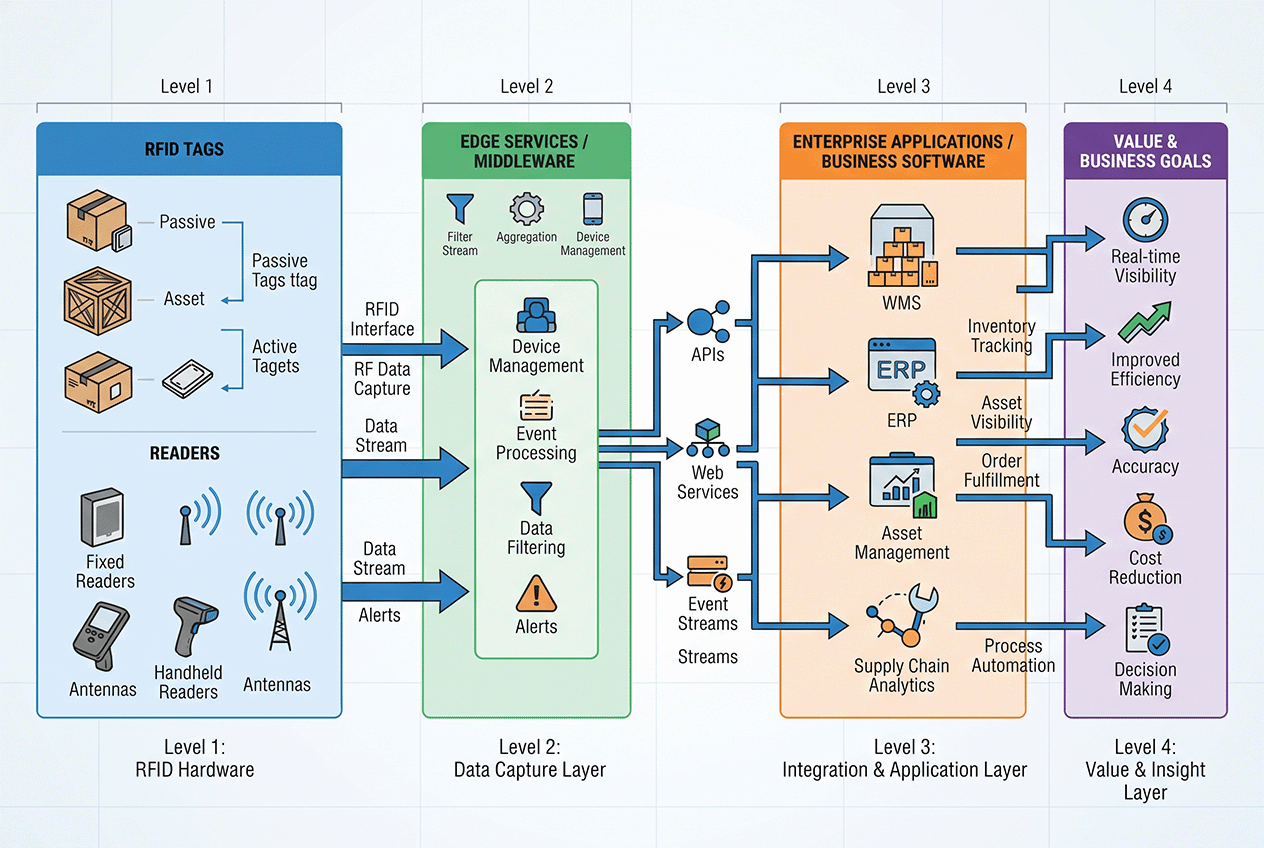
Software integration turns captured data into business value. RFID data must flow into software that processes it and integrates with your business systems — inventory management, asset tracking, ERP, or other applications — so the data drives the outcomes you need. Plan how the reader data connects to middleware or software that filters and processes it, and how that integrates with your existing systems. The integration determines whether RFID data becomes useful information and action, rather than just raw reads. Designing the software and integration is as important as the hardware, since the data's value is realized through the systems that use it. Planning how RFID data flows into and integrates with your business software ensures the captured data delivers value. The software integration, connecting reader data to your business systems, completes the system by turning tag reads into the information and actions that achieve your goals, making integration planning essential to a deployment that delivers business value rather than merely capturing data that goes unused.
Step 6: Pilot before scaling
Piloting validates the design before full deployment. Implementing a pilot — a limited deployment testing the system in real conditions — reveals whether the design works as intended and what needs adjustment before scaling. A pilot tests tags, readers, infrastructure, and integration together in practice, catching issues while they are inexpensive to fix and providing confidence and learning before broader rollout. Validating the design through a pilot, then refining based on results, reduces the risk of scaling a flawed design. The pilot is a prudent step that tests the real system and informs adjustments. Running a pilot to validate and refine the design before scaling ensures the full deployment rests on a proven, tested system. The pilot stage, testing the design in reality before committing to scale, is a valuable safeguard that catches problems and builds confidence, making it an important step in designing an RFID system that works at scale, after which the refined design can be deployed more broadly with the assurance that it has been validated in practice with real conditions and requirements.
Step 7: Scale and optimize
Scaling rolls out the validated design across the full deployment, with ongoing optimization. After the pilot confirms and refines the design, scaling extends it to the full scope — more locations, items, or operations — applying the proven approach. As the system scales, monitoring performance and optimizing based on experience keeps it working well. Scaling a validated design reduces risk, and ongoing optimization ensures the system continues to deliver value as it operates and as needs evolve. The scaling and optimization stage realizes the full benefit of the designed system across the operation. Rolling out the proven design and continuously optimizing ensures the system delivers value at full scale over time. As a manufacturer of RFID tags and components, our team supports businesses designing and deploying RFID systems, providing tags suited to the application and guidance on the choices that make a system work. To discuss designing an RFID system for your business, contact our team for support with the tags and approach your deployment requires.
Frequently Asked Questions
How do I start designing an RFID system?
Start by clearly defining your goals and requirements: the business problem you are solving, the outcomes you need, what must be tracked, where, with what accuracy, and integrated with what systems. This clarity guides every subsequent technical decision, ensuring the system addresses your actual needs.
How do I choose the right RFID frequency?
Match the frequency to your application. UHF offers longer range and fast bulk reading for inventory and supply chain; HF and NFC offer short range for access, payments, and engagement; LF suits specific uses like animal tracking. Your range needs, reading requirements, and application determine the choice.
Why is a pilot important before scaling RFID?
A pilot tests the design — tags, readers, infrastructure, and integration — together in real conditions before full deployment, revealing whether it works and what needs adjustment. It catches issues while they are inexpensive to fix and builds confidence, reducing the risk of scaling a flawed design.
How does RFID integrate with business software?
RFID reader data flows into middleware that filters and processes it, then integrates with business systems like inventory management, asset tracking, or ERP, so the data drives outcomes. This integration turns raw tag reads into useful information and action, which is where the data's business value is realized.
Can a manufacturer help design my RFID system?
A tag manufacturer can provide tags suited to your application and conditions and offer guidance on choices like tag type, chip, and frequency that affect system performance. While full system design may involve integrators, the right tags and component guidance are an important part of a working deployment.
Design your RFID system on the right foundation
We help businesses choose and produce tags suited to their application and conditions, and offer guidance on the choices that make a system work — supporting your deployment from design through scale.
Discuss your system design Explore RFID tags