


We will cover what RAIN RFID is, its relationship to UHF and EPC Gen2, the role of the alliance, the benefits, key applications, and how to adopt it.
Key takeaways
- RAIN RFID is passive UHF RFID based on the EPC Gen2 standard.
- The name unifies the technology under a common identity, like Wi-Fi or Bluetooth.
- It delivers long read range and fast bulk reading of many tags.
- RAIN RFID drives retail, supply-chain, and inventory applications at scale.
What RAIN RFID is
RAIN RFID is a name for passive ultra-high-frequency RFID operating in the UHF band (around 860–960 MHz) based on the EPC Gen2 standard. The name RAIN — a nod to RAdio frequency IdentificatioN — was introduced by an industry alliance to give this widely-used technology a common, recognizable identity. RAIN RFID tags are passive, drawing power from the reader, and offer the long range and bulk-reading capability characteristic of UHF. So when you encounter RAIN RFID, you are encountering passive UHF RFID with an ecosystem and identity built around it. The term does not denote a different technology but rather a unified name and promotional framework for UHF RFID. Understanding that RAIN RFID is passive UHF RFID on the EPC Gen2 standard, given a common name, clarifies the terminology, where recognizing RAIN RFID as the familiar UHF technology under a unifying identity removes confusion and frames it within the ecosystem promoting its adoption across industries.
The relationship to UHF and EPC Gen2
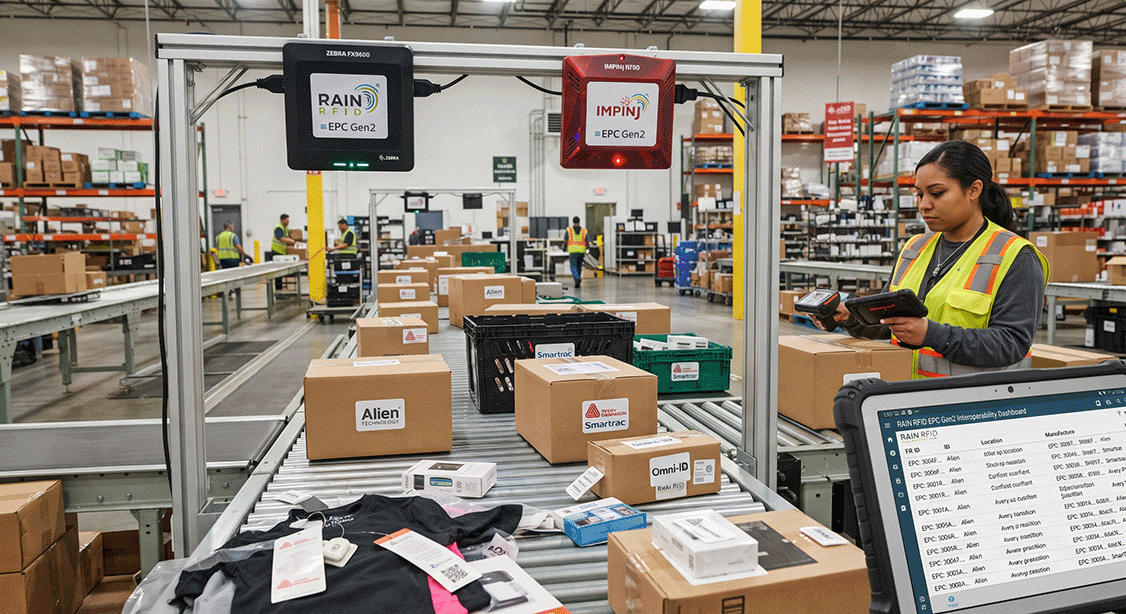
RAIN RFID, UHF, and EPC Gen2 are closely related. UHF refers to the frequency band (860–960 MHz) RAIN RFID uses. EPC Gen2 — formally the EPCglobal UHF Class 1 Generation 2 standard, also standardized internationally as ISO 18000-63 — is the air-interface standard defining how UHF tags and readers communicate, ensuring interoperability. RAIN RFID is the name for passive UHF RFID built on this EPC Gen2 standard. So the frequency band (UHF), the communication standard (EPC Gen2), and the unifying name (RAIN RFID) together describe the technology. This standardization on EPC Gen2 is what enables interoperability — tags and readers from different makers working together — which underpins the large-scale adoption RAIN RFID enables. Understanding that RAIN RFID is passive UHF on the EPC Gen2 standard clarifies how the terms relate, where the combination of the UHF band, the EPC Gen2 standard, and the RAIN name describes one interoperable technology that scales across the supply chain.
The role of the RAIN alliance
An industry alliance promotes RAIN RFID, driving its adoption and ecosystem. Much as industry groups promote Wi-Fi and Bluetooth, the RAIN alliance unites companies across the UHF RFID ecosystem — chip makers, tag manufacturers, reader makers, and solution providers — to promote the technology, support its growth, and provide a common identity. This collective effort helps drive awareness, adoption, and the development of the ecosystem around UHF RFID. The alliance's promotion gives the technology a unified voice and identity that supports its spread across industries. For the broader market, this ecosystem and promotion accelerate UHF RFID adoption and innovation. Understanding that an industry alliance promotes RAIN RFID and builds its ecosystem explains the organizational force behind the technology's growth, where the collective promotion and ecosystem development, uniting the companies involved in UHF RFID, helps drive the adoption and innovation propelling RAIN RFID across retail, supply chain, and beyond.
The benefits of RAIN RFID
RAIN RFID's benefits are those of passive UHF, which make it transformative for many applications. Its long read range, far exceeding HF and LF, allows reading tags from a distance, enabling applications like reading a whole pallet or shelf at once. Its fast bulk reading lets readers capture many tags nearly simultaneously, making inventory counts that took hours possible in moments. Its passive tags are affordable and maintenance-free, suiting high-volume tagging. These capabilities enable the inventory accuracy, supply-chain visibility, and operational efficiency that RAIN RFID is known for. The combination of range, speed, and affordability is why UHF RAIN RFID drives large-scale tagging applications. Understanding that RAIN RFID delivers long range, fast bulk reading, and affordable passive tags explains its transformative value, where these capabilities enable the high-volume, long-range applications in retail and supply chain that have made RAIN RFID the technology behind item-level tagging and inventory accuracy at scale.
Key applications
RAIN RFID powers major applications across industries. In retail, item-level tagging with RAIN RFID delivers inventory accuracy, stock visibility, and omnichannel fulfillment, transforming retail operations. In supply chain and logistics, RAIN RFID tracks goods through the chain, providing visibility from manufacturing to delivery. In warehousing, it speeds inventory and improves accuracy. In manufacturing, it tracks assets and work in progress. These applications leverage RAIN RFID's range and bulk-reading to manage large numbers of items efficiently, the use cases that have driven its adoption. The technology's ability to track many items over distance suits the high-volume needs of these industries. Understanding that RAIN RFID drives retail inventory, supply-chain visibility, warehousing, and manufacturing applications shows where it delivers value, where the long-range bulk reading of RAIN RFID enables the large-scale item tracking that supply chains and retailers depend on for inventory accuracy and operational efficiency.

How to adopt RAIN RFID
Adopting RAIN RFID involves the components of any UHF deployment: tags suited to your items, readers to capture them, and systems to use the data. Selecting EPC Gen2 RAIN RFID tags appropriate to your application and environment, deploying suitable reading infrastructure, and integrating the data into your systems brings RAIN RFID's benefits to your operation. Because RAIN RFID is standardized on EPC Gen2, the ecosystem offers interoperable products to build a solution. Working with a knowledgeable manufacturer helps select the right tags and plan the deployment. As a manufacturer of UHF RAIN RFID tags, our team produces EPC Gen2 tags for retail, supply-chain, and inventory applications, helping customers adopt RAIN RFID effectively. To adopt RAIN RFID for your application, contact our team for guidance on the right EPC Gen2 UHF tags and approach for your retail, warehouse, or supply-chain needs.
Frequently Asked Questions
What is RAIN RFID?
RAIN RFID is a name for passive ultra-high-frequency RFID operating around 860–960 MHz based on the EPC Gen2 standard. The name, a nod to RAdio frequency IdentificatioN, was introduced by an industry alliance to give this widely-used UHF technology a common, recognizable identity, like Wi-Fi or Bluetooth.
Is RAIN RFID different from UHF RFID?
No, RAIN RFID is essentially passive UHF RFID built on the EPC Gen2 standard, given a unifying name and industry ecosystem. UHF refers to the frequency band, EPC Gen2 to the communication standard, and RAIN RFID to the technology and identity built around them — the same technology, not a different one.
What is EPC Gen2?
EPC Gen2 — formally the EPCglobal UHF Class 1 Generation 2 standard, also standardized as ISO 18000-63 — is the air-interface standard defining how passive UHF tags and readers communicate. It ensures interoperability between tags and readers from different makers, underpinning the large-scale adoption RAIN RFID enables.
What are the benefits of RAIN RFID?
RAIN RFID offers long read range that allows reading tags from a distance, fast bulk reading that captures many tags nearly simultaneously, and affordable, maintenance-free passive tags. These enable inventory accuracy, supply-chain visibility, and operational efficiency for high-volume applications at scale.
What is RAIN RFID used for?
RAIN RFID powers retail item-level tagging for inventory accuracy and omnichannel fulfillment, supply-chain and logistics tracking for end-to-end visibility, warehousing for faster, more accurate inventory, and manufacturing for asset and work-in-progress tracking — applications needing long-range, high-volume item tracking.
Adopt RAIN RFID for your operation
As a manufacturer of UHF RAIN RFID tags built on EPC Gen2, we help you select the right tags and adopt RAIN RFID for retail, warehouse, and supply-chain applications at scale.
Discuss your RAIN RFID project Explore UHF RFID tags