


We will cover RFID as IoT's sensing layer, how identification feeds intelligence, sensor-enabled tags, smart environments, real-world applications, and building RFID-IoT systems.
Key takeaways
- IoT needs to know about physical objects; RFID provides that identification.
- RFID is a sensing layer feeding data to IoT systems that analyze and act.
- Sensor-enabled tags add condition data like temperature to identity.
- Together they enable smart retail, logistics, healthcare, and more.
RFID as the sensing layer for IoT
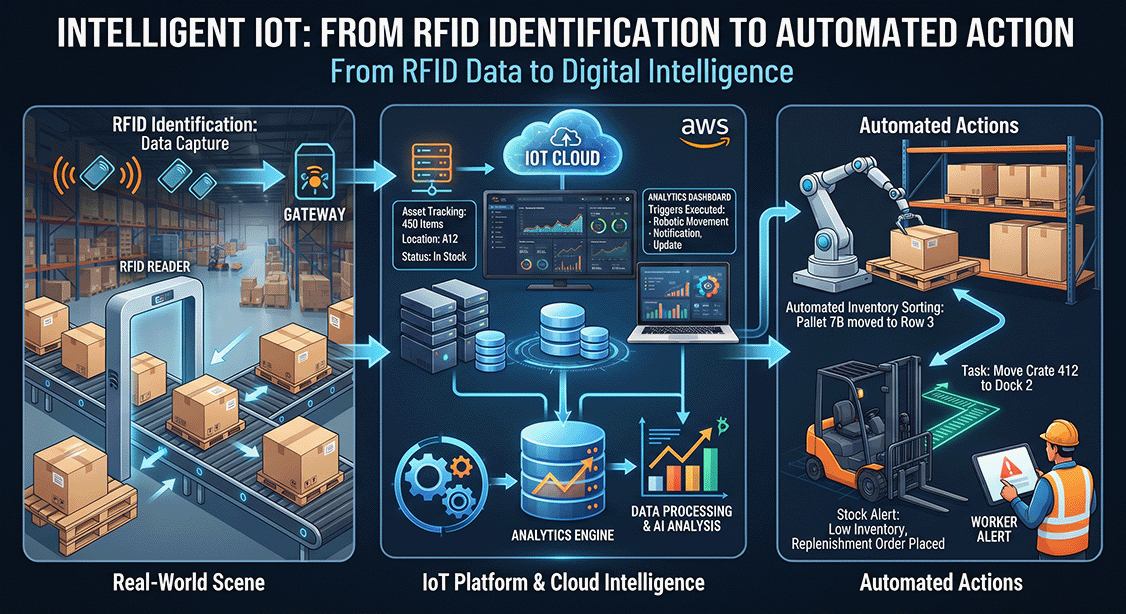
IoT systems connect physical things to digital intelligence, and they need ways to sense the physical world. RFID serves as one such sensing layer, giving physical objects a readable identity that IoT systems can capture. When RFID readers, connected to the IoT system, read tagged objects, they feed the system data about what objects are present, where, and when — the raw input the IoT system needs to understand the physical situation. In this role, RFID is the bridge between physical objects and the digital IoT system, translating the presence and identity of real things into data the system can use. Understanding that RFID provides IoT's sensing of object identity and presence explains its foundational role, where RFID acts as the layer that lets IoT systems perceive the physical objects they manage, supplying the identification data that connected intelligence requires to understand and act on the physical world.
How identification feeds intelligence
The data RFID provides becomes the input for IoT intelligence. Once an IoT system knows which objects are present and how they move — from RFID reads — it can analyze this information, combine it with other data, and act intelligently. Knowing an item's location and movement lets the system update inventory, trigger actions, optimize processes, or alert to anomalies. The identification RFID provides is the foundation on which IoT analytics and automation build, since intelligent action requires knowing what is happening physically. Without identification of objects, IoT intelligence about those objects has no foundation. Understanding that RFID identification feeds the analytics and automation of IoT explains the synergy, where the object data RFID supplies enables the intelligent processing and action that defines IoT, making RFID's identification the essential input that turns connected systems into intelligent ones capable of understanding and responding to the physical world.
Sensor-enabled tags: beyond identity
Advanced RFID tags extend the sensing layer beyond identity to condition. While basic tags provide identification, sensor-enabled tags can also capture environmental data such as temperature, adding condition information to the identity they provide. This is valuable for IoT applications monitoring not just where objects are but their state — a cold-chain shipment's temperature, for instance, monitored alongside its identity. Sensor tags enrich the data RFID feeds to IoT, enabling systems to act on conditions as well as presence. This expands RFID's role in IoT from identifying objects to sensing aspects of their environment, deepening the intelligence possible. Understanding that sensor-enabled tags add condition data to identity explains how RFID's contribution to IoT can extend beyond location to state, where tags that sense temperature or other conditions feed richer data to IoT systems, enabling monitoring and action based on object conditions, not just their presence, broadening the smart-system capabilities RFID supports.
Building smart environments
Smart environments emerge when RFID-fed IoT systems make spaces responsive and intelligent. In a smart retail store, RFID inventory data feeds systems that track stock and inform operations. In a smart warehouse, RFID and IoT coordinate inventory and movement. In smart healthcare, RFID tracks assets and patients, feeding systems that improve care and efficiency. In these environments, the physical space becomes intelligent because RFID gives the IoT system awareness of the objects within it. The combination creates environments that sense, understand, and respond — the essence of smart systems. Understanding that RFID-enabled IoT creates responsive smart environments shows the broader vision, where giving connected systems awareness of physical objects through RFID transforms ordinary spaces into intelligent environments across industries, from retail to healthcare, that sense and respond to what is happening within them through the identification RFID provides.
Wearable and personal IoT
Wearable RFID, such as smart wristbands, brings people into IoT systems. RFID wristbands let individuals interact with smart environments — accessing areas, making payments, or triggering personalized experiences — connecting people to the IoT system much as tags connect objects. In smart venues, resorts, or events, wearable RFID integrates guests into the connected environment, enabling seamless, personalized experiences. This extends the RFID-IoT relationship to people, where a wristband becomes the individual's connection to the smart system. Wearable RFID makes people participants in IoT environments, their interactions sensed and responded to. Understanding that wearable RFID connects people to IoT systems shows how the technology extends beyond objects to individuals, where smart wristbands let people interact with and be served by connected environments, integrating guests and users into the smart systems that RFID and IoT create, enabling the personalized, seamless experiences that define smart venues and connected personal applications.

Real-world RFID-IoT applications
RFID-IoT systems are transforming many domains. In retail, they enable inventory accuracy, smart shelves, and responsive operations. In supply chain and logistics, they provide end-to-end visibility and condition monitoring. In manufacturing, they support smart factories where assets and processes are tracked and optimized. In healthcare, they improve asset, patient, and inventory management. In smart cities and buildings, they enable connected, efficient operations. Across these applications, RFID provides the physical-world sensing that makes the IoT intelligence possible. The breadth of applications reflects how fundamental object identification is to connected systems. Understanding the range of RFID-IoT applications shows the technology's broad impact, where the identification RFID provides underpins smart systems across industries, enabling the connected, intelligent operations that IoT promises by giving those systems the awareness of physical objects they need to deliver value.
Building an RFID-IoT system
Creating an RFID-IoT system combines the right tags, readers, connectivity, and intelligence. Suitable RFID tags identify the objects or people involved, readers connected to the IoT infrastructure capture the data, and the IoT system analyzes and acts on it. Designing the system means selecting components that work together to deliver the sensing and intelligence the application needs. A capable RFID manufacturer provides the tags and guidance for the sensing layer, supporting the broader IoT system. As a manufacturer of RFID tags and wristbands for connected applications, our team produces the RFID products that serve as the sensing layer for smart systems, helping customers build RFID-IoT solutions. To build an RFID-enabled IoT system, contact our team for the tags and wristbands that connect your physical world to intelligent systems.
Frequently Asked Questions
How do RFID and IoT work together?
RFID provides IoT systems with identification of physical objects — which objects are where and how they move — serving as a sensing layer. IoT systems capture this data through connected readers, then analyze it and act intelligently. RFID is the bridge connecting physical objects to IoT's digital intelligence.
Why does IoT need RFID?
For IoT to act on the physical world, it must first know about it — which objects are present, where, and how they move. RFID provides this identification, giving IoT systems awareness of physical objects. Without identification of objects, IoT intelligence about those objects has no foundation to build on.
What are sensor-enabled RFID tags?
Sensor-enabled tags capture environmental data such as temperature in addition to identity, adding condition information to identification. This lets IoT systems monitor not just where objects are but their state — such as a cold-chain shipment's temperature — enabling action based on conditions as well as presence.
How does wearable RFID fit into IoT?
Wearable RFID like smart wristbands connects people to IoT systems, letting individuals access areas, make payments, or trigger personalized experiences. In smart venues and events, wearable RFID integrates guests into the connected environment, extending the RFID-IoT relationship from objects to people.
What industries use RFID-IoT systems?
Retail (inventory accuracy, smart shelves), supply chain and logistics (end-to-end visibility, condition monitoring), manufacturing (smart factories), healthcare (asset, patient, and inventory management), and smart cities and buildings all use RFID-IoT systems, with RFID providing the physical-world sensing for IoT intelligence.
Build the sensing layer for your smart system
As a manufacturer of RFID tags and wristbands for connected applications, we produce the products that connect your physical world to intelligent IoT systems.
Discuss your IoT project Explore RFID tags