


We will cover the core components, how a tag and reader communicate, passive versus active tags, the frequency bands, how data is read, and where each type fits.
Key takeaways
- RFID uses a tag (chip plus antenna) and a reader communicating over radio waves.
- Passive tags draw power from the reader; active tags have their own battery.
- Low, high, and ultra-high frequency bands suit different ranges and uses.
- No line of sight is needed, and many tags can be read quickly.
The core components: tag, antenna, reader
An RFID system has three essential parts. The tag consists of a microchip (the integrated circuit, or IC) that stores data and an antenna that sends and receives radio signals — together small enough to embed in a label, card, or product. The reader (also called an interrogator) is a device with its own antenna that communicates with tags, sending signals and receiving the data tags return. Behind the reader, software and systems process the data for whatever the application needs. These three elements — tag, reader, and the system behind it — form every RFID deployment. The tag carries the identity, the reader retrieves it, and the system uses it. Understanding this basic architecture, where a tag holds data that a reader retrieves wirelessly for a system to use, is the foundation for understanding how RFID works. Everything else — frequencies, tag types, ranges — builds on this simple structure of tag, reader, and the information exchanged between them over radio waves.
How a tag and reader communicate
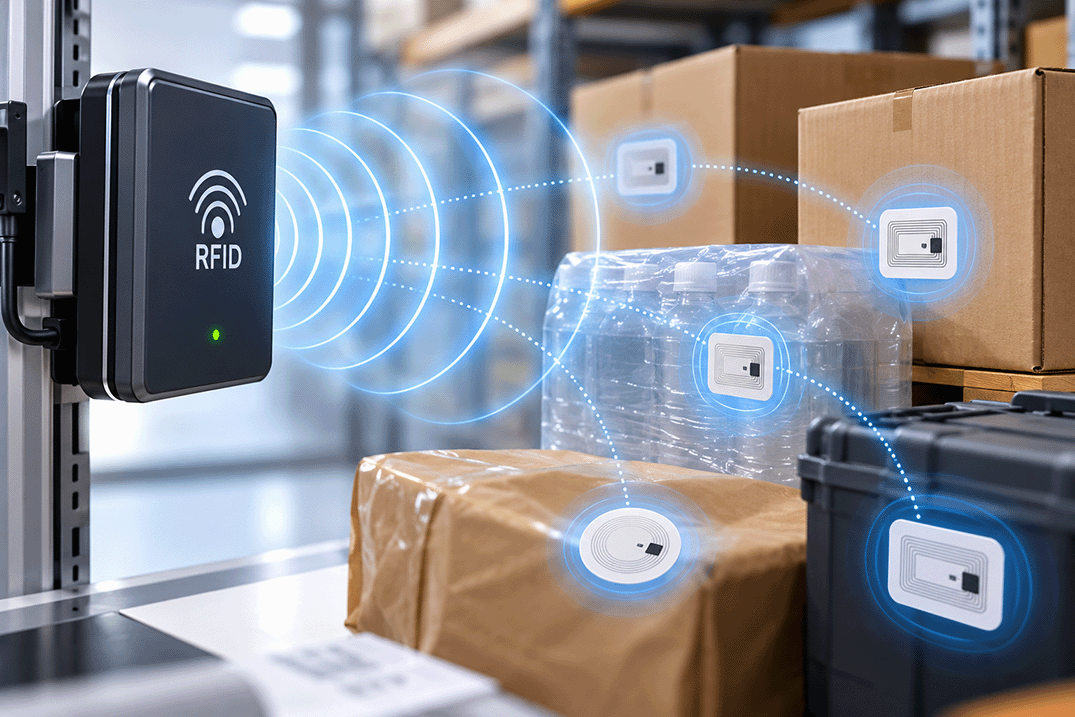
Communication happens over radio waves, without contact or line of sight. The reader's antenna emits radio-frequency energy, creating a field around it. When a tag enters this field, its antenna picks up the signal, and the tag responds by transmitting its stored data back to the reader. The reader receives this response and passes the data to the system. This exchange happens in moments, and crucially requires no physical contact and no line of sight — the tag can be read through packaging, inside a wallet, or among many other items. This is RFID's defining advantage over barcodes, which must be seen to be scanned. The wireless exchange of energy and data between reader and tag, working without contact or visibility, is what makes RFID so powerful for identification and tracking. Understanding that the reader powers and queries the tag, and the tag responds with its data, all over radio waves, explains the contactless, no-line-of-sight reading that defines RFID technology and distinguishes it from optical methods like barcodes.
Passive versus active tags
A fundamental distinction is whether a tag has its own power source. Passive tags have no battery; they draw all their energy from the reader's radio field, using it to power the chip and transmit a response. This makes passive tags small, inexpensive, and long-lived, since there is no battery to deplete — they are by far the most common type, used in cards, labels, and most tagging applications. Active tags contain their own battery, which powers the chip and lets them transmit signals over much greater distances, sometimes continuously. Active tags are larger, costlier, and have a battery life, but suit applications needing long range or continuous signaling, such as tracking large assets over distance. Most everyday RFID — the cards and labels people encounter — is passive, powered by the reader. Understanding that passive tags draw power from the reader while active tags carry their own battery explains the difference in size, cost, range, and use between the two types, with passive tags dominating most applications and active tags reserved for long-range needs.
The frequency bands explained
RFID operates across several frequency bands, each with different characteristics. Low frequency (LF), around 125–134 kHz, offers short read range but works well near metal and liquids, used in animal identification and access control. High frequency (HF), at 13.56 MHz, offers short range and is used in cards, tickets, and — as the basis of NFC — many tap applications. Ultra-high frequency (UHF), around 860–960 MHz, offers much longer read range and fast bulk reading, making it the choice for inventory, supply chain, and logistics where many items are read quickly from a distance. Each band's physics suit different jobs: LF for difficult environments at short range, HF for secure short-range interactions, and UHF for long-range, high-volume tracking. Understanding that the frequency band determines read range, behavior near materials, and suitability explains why different applications use different RFID frequencies, and why choosing the right frequency for an application is fundamental to RFID system design.
How data is read and processed
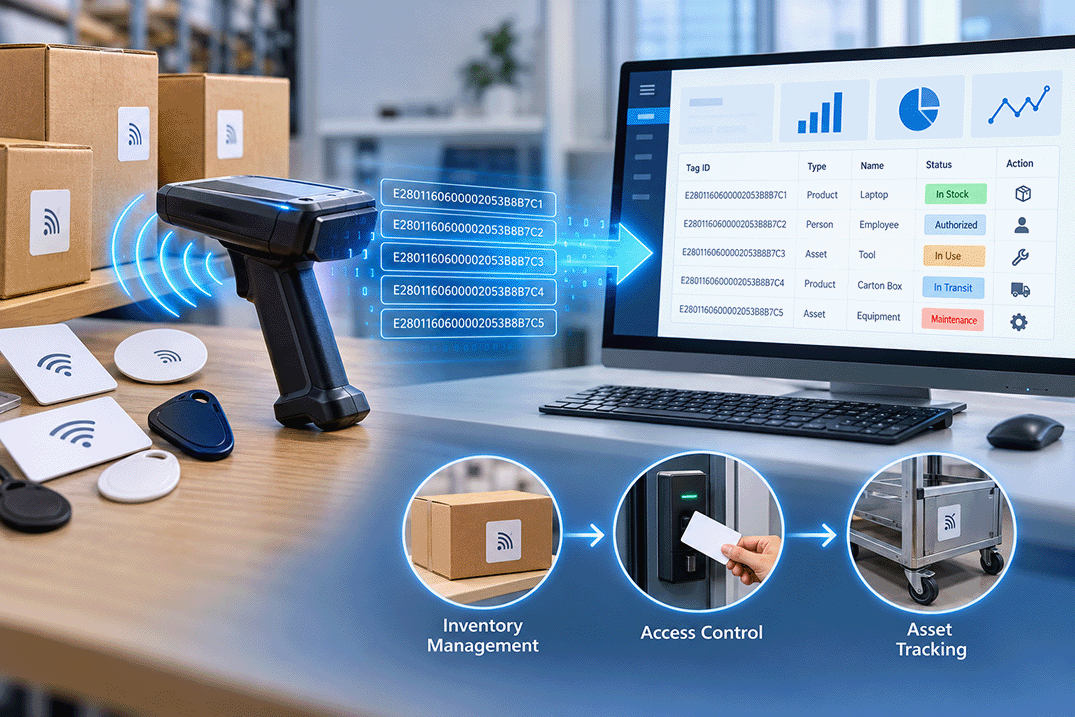
Reading data turns the tag's response into useful information. When the reader receives a tag's transmitted data — typically a unique identifier and any stored information — it passes this to the connected system, which interprets it for the application. The identifier might link to a database record, trigger an action, or update an inventory count. The reader can read many tags rapidly, and with UHF, hundreds in moments, enabling fast bulk operations. The system behind the reader gives meaning to the raw identifiers, connecting a tag's data to the product, person, or asset it represents and the action required. This flow — reader retrieves data, system interprets and acts — is how RFID delivers value, turning wireless tag reads into inventory counts, access decisions, or tracking updates. Understanding that the reader captures tag data and the system processes it into meaningful action explains how RFID moves from a wireless read to a useful outcome, with the system translating tag identities into the information and actions the application requires.
No line of sight, many tags at once
Two capabilities set RFID apart from barcodes. First, no line of sight is required — tags read through packaging, materials, and obstructions, and in any orientation, unlike barcodes that must be visible and aligned to a scanner. This allows reading tags inside boxes, on items in a bag, or embedded in products. Second, many tags at once — RFID readers, especially UHF, can read many tags nearly simultaneously, counting a whole carton or shelf in moments rather than scanning items one by one. These capabilities enable applications impossible with barcodes: instant inventory counts, hands-free access, and bulk reading of grouped items. Together, no-line-of-sight reading and bulk reading make RFID far faster and more flexible than optical scanning for many tasks. Understanding these defining advantages explains why RFID is transformative for inventory, logistics, and access, where the ability to read concealed tags and many tags at once, demonstrated across countless applications, delivers speed and capability that barcodes cannot match.
Where each RFID type fits
Matching type to application follows from these fundamentals. LF suits animal ID and access where short range near difficult materials is needed. HF suits cards, tickets, and NFC taps where secure short-range interaction matters. UHF suits inventory, supply chain, and logistics where long range and bulk reading are essential. Passive tags suit the vast majority of applications needing affordable, maintenance-free tagging, while active tags suit long-range asset tracking. The right combination of frequency and tag type depends on the application's range, environment, volume, and cost needs. Understanding how the characteristics map to applications helps you grasp why a particular RFID type is chosen for a particular job. As a manufacturer producing RFID across frequencies and types, our team helps customers select the right technology for their application. To understand which RFID type fits your needs, contact our team, and explore our range of RFID products suited to applications across the frequency bands.
Frequently Asked Questions
How does RFID work in simple terms?
An RFID tag (a chip plus an antenna) stores data, and a reader communicates with it over radio waves. The reader emits a radio field that powers passive tags and queries them; the tag responds with its data, which the reader passes to a system. No contact or line of sight is needed.
What is the difference between passive and active RFID tags?
Passive tags have no battery and draw power from the reader's radio field, making them small, inexpensive, and long-lived — the most common type. Active tags have their own battery, enabling much longer range and continuous transmission, but are larger and costlier, suited to long-range asset tracking.
What are the RFID frequency bands?
Low frequency (125–134 kHz) offers short range but works near metal and liquids; high frequency (13.56 MHz) offers short range and underlies NFC; ultra-high frequency (860–960 MHz) offers long range and fast bulk reading for inventory and logistics. Each band suits different applications.
Why doesn't RFID need line of sight?
Because it communicates over radio waves rather than light, RFID can read tags through packaging, materials, and obstructions in any orientation, unlike barcodes that must be visible and aligned. This allows reading concealed tags and many tags at once, a key advantage over optical scanning.
What is the difference between RFID and NFC?
NFC is a specific subset of high-frequency RFID operating at 13.56 MHz at very short range, designed for secure tap interactions often with smartphones. RFID is the broader technology spanning low, high, and ultra-high frequencies for a wide range of identification and tracking applications.
Choose the right RFID technology for your application
As a manufacturer producing RFID across the frequency bands and tag types, we help you select the technology — LF, HF, UHF, passive or active — that fits your range, environment, and goals.
Discuss your application Explore RFID tags