


So the case must be narrower and more honest: RFID is worth its cost only where the printed code cannot be read — through a sealed carrier, inside a stacked magazine, deep in a rack, at a distance, in bulk, without a person or a camera aiming at something. That is a smaller domain than vendors suggest, and inside it the returns are unusually large.
Key takeaways
- Electronics already has free serialisation; RFID must beat a printed code.
- Its domain is where no line of sight exists: sealed carriers, magazines, racks.
- Working capital tied up in WIP is the recurring line.
- The bounded recall is the rare, enormous line — and it is insurance-shaped.
Start by conceding the 2D code
Free is a formidable competitor. A laser-marked data-matrix on a printed circuit board survives reflow, costs nothing per unit, and is read by machine vision at every station without additional hardware. It carries a serial, and a serial is all traceability requires. Against that, a tag costs cents, requires a reader, and — this is the fact most proposals omit — cannot survive a reflow oven, so it cannot live on the board at all. Any honest case therefore begins by conceding that for station-level traceability on an assembled board, the code has already won. The mistake is to conclude that RFID has no place. The right conclusion is that its place is defined by an absence: the moments in the process when nobody can see the code, because the boards are stacked in a magazine, sealed in a moisture barrier bag, boxed in a carrier, or on a rack thirty metres away. Understanding where line of sight disappears is where the electronics case actually begins.
The first line: working capital in work-in-progress
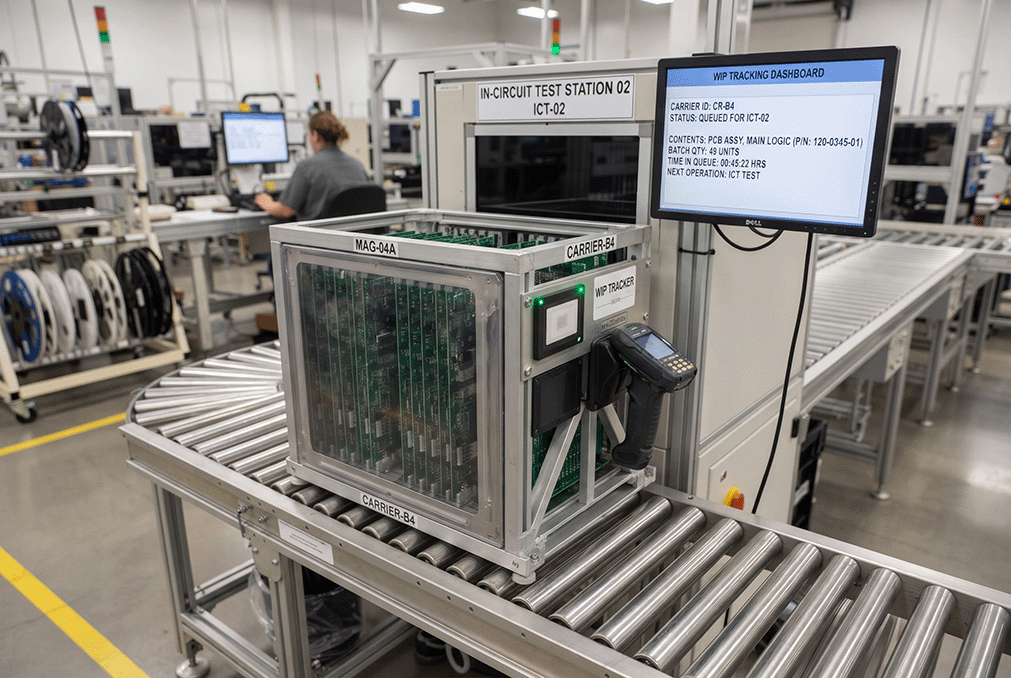
Cycle time is cash. A plant's work-in-progress inventory is money that has been spent and not yet earned, and its size is a direct function of how long a unit spends between stations, in queues, in bonded stores, waiting for a test slot, or lost in a rack. Tagging the carrier — the magazine, the tote, the rack — rather than the board gives continuous visibility of where every batch is, without any line of sight, and it exposes the queues nobody measures. Plants that instrument carriers routinely discover that a large fraction of cycle time is dwell in front of test, and that a small number of batches are simply lost for days. Reducing average cycle time reduces the WIP balance proportionally, and the saving is recurring, financial, and easy to defend to a treasurer. Understanding that the recurring line in an electronics case is working capital rather than labour — and that it is bought by tagging carriers, not boards — is the substance of the argument.
The second line: bounding a recall
This is where the money is, and it is insurance-shaped. When a component lot proves defective — a capacitor, a connector, a firmware-carrying chip — the recall's cost is set by how precisely the manufacturer can say which finished units contain it. With coarse records, the answer is "everything built in that quarter", and half a million units are recalled to catch eight thousand. With genealogy that binds component lot to carrier to board serial to finished unit, the recall is bounded to the units that actually contain the part. The difference is not a percentage improvement; it is two orders of magnitude, in a line item that can exceed a year's operating profit. Because it happens rarely, it is systematically under-weighted in business cases and correctly weighted by risk committees and insurers. Present it as insurance: an annual premium, in tags and readers, against a loss whose distribution you can estimate from your own field-failure history. Understanding that genealogy through the invisible parts of the process is the largest single number in electronics RFID is what changes who signs the business case.
The third line: counterfeit components at goods-in
The threat arrives on a reel. Counterfeit and recycled components enter through brokers and grey channels during shortages, and their cost surfaces years later as field failures whose root cause is hard to establish. Serialised reels and trays, tagged by a supplier and verified at goods-in without opening the moisture barrier bag, allow authenticity and provenance to be checked at the moment of receipt rather than after a failure. This works only if suppliers participate, and their willingness varies; the leverage exists for large buyers and rarely for small ones. Treat it as a benefit that is real but conditional, and do not build the case on it. Understanding that supply-chain authentication in electronics is a partnership problem rather than a technology problem — and pricing it conservatively — keeps the case credible when a procurement director asks which suppliers have actually agreed.
The fourth line: tools, fixtures, and ESD assets
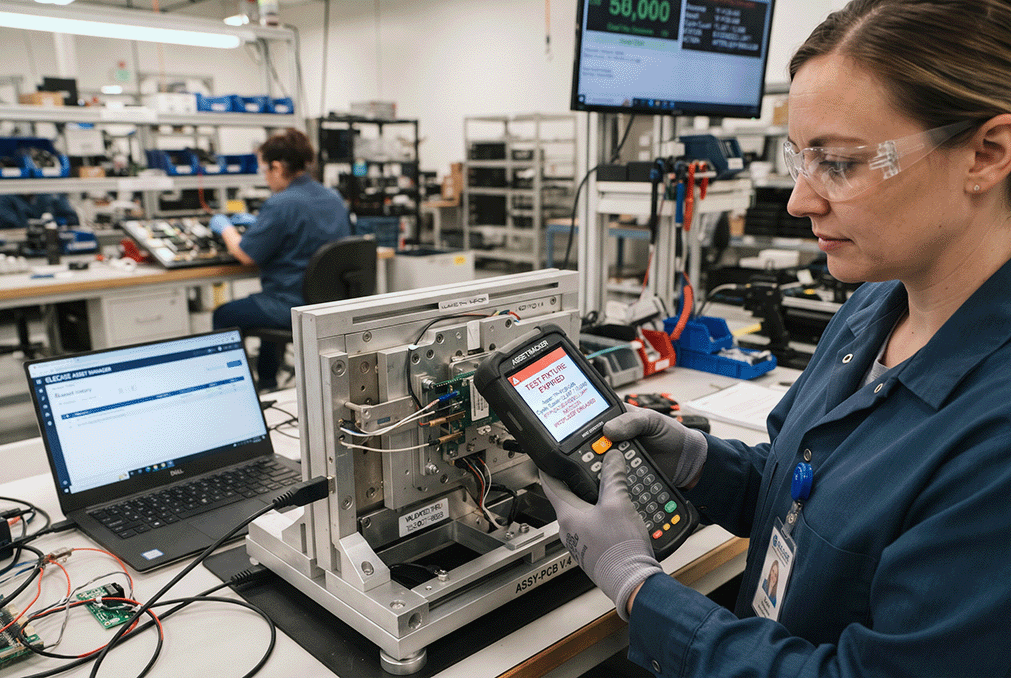
The unglamorous line that always pays a little. Test fixtures have a validated cycle count and are used past it. Torque drivers and probes have calibration dates that expire in a drawer. ESD wrist straps, mats, and ionisers require periodic verification, and the records are kept on paper. Solder paste and moisture-sensitive devices have floor-life clocks that begin when a bag is opened. Every one of these is an asset with a state that nobody can see, and every one is a plausible cause of a quality escape. A tag on a fixture, a driver, or a bag turns an audit into a read and an expiry into an interlock — the fixture that will not start, the bag that is flagged before it is opened. It never justifies a programme alone, and it always improves the payback of one funded by the lines above. Understanding that on-metal asset tagging is the reliable supporting argument — modest, certain, and audit-friendly — is what makes an electronics case robust rather than heroic.
What will make the case fail
Three specific hazards. First, tags on boards: reflow destroys them, and a proposal that puts a tag on a PCB will be dismissed by the first process engineer who reads it. Tag carriers, magazines, trays, and racks. Second, electrostatic discharge and RF noise: the plant is full of both, tags and their mounts must not compromise ESD control, and readers must be sited so that automated equipment is not affected — a test that belongs in the cell, at production speed. Third, the temptation to over-scope: a proposal that tags everything, everywhere, competes with a free code and loses. Scope to the blind spots, price the tags as consumables and the readers as capital, and present the recall line as risk rather than savings. Understanding that an electronics case fails on process realities rather than on economics is what separates the programmes that reach production from the pilots that quietly end in a storeroom.
Getting started
To get started, map the process and mark every point at which no camera can see a code. Those points are the scope. Estimate the WIP balance and the average cycle time, and instrument the carriers through the two longest queues. Retrieve your field-failure and recall history and compute what a bounded recall would have saved on the last one; that number, not the labour saving, is the case. Add fixture and calibration tagging to the same programme. Test reads inside a cell, at speed, with ESD controls verified. As a manufacturer of RFID tags and on-metal constructions, our team supplies carrier, magazine, rack, and fixture tags. To build an electronics case, contact our team.
Frequently Asked Questions
Why is RFID a hard sell in electronics?
Because the sector already serialises nearly everything with a laser-marked 2D code that survives reflow, costs essentially nothing, and is read by machine vision already installed on the line. A tag costs cents, needs a reader, and cannot survive a reflow oven, so it cannot live on the board at all. For station-level traceability on an assembled board, the printed code has already won. RFID's domain is the absence of line of sight: stacked magazines, sealed bags, boxed carriers, and distant racks.
What is the recurring financial benefit?
Working capital tied up in work-in-progress. WIP is money spent and not yet earned, and its size is a direct function of how long a unit spends between stations, in queues, in bonded stores, waiting for a test slot, or lost in a rack. Tagging the carrier — magazine, tote, rack — rather than the board gives continuous visibility without line of sight and exposes the queues nobody measures. Reducing average cycle time reduces the WIP balance proportionally, and that saving recurs.
How does RFID bound a recall?
By binding component lot to carrier to board serial to finished unit. When a component lot proves defective, the recall's cost is set by how precisely you can say which finished units contain it. With coarse records the answer is everything built that quarter — half a million units recalled to catch eight thousand. With genealogy the recall is bounded to the units that actually contain the part. That is two orders of magnitude, in a line item that can exceed a year's operating profit.
Should the business case rest on counterfeit component detection?
No — treat it as real but conditional. Counterfeit and recycled components arrive through brokers during shortages, and their cost surfaces years later as field failures. Serialised reels and trays tagged by a supplier can be verified at goods-in without opening the moisture barrier bag. But this depends entirely on supplier participation, and the leverage exists for large buyers and rarely for small ones. Price it conservatively and be ready to name which suppliers have actually agreed.
What kills an electronics RFID proposal?
Three things. Putting a tag on a PCB: reflow destroys it, and the first process engineer to read the proposal will dismiss it — tag carriers, magazines, trays, and racks instead. Ignoring electrostatic discharge and RF noise: tags and mounts must not compromise ESD control, and readers must not disturb automated equipment, which is a test to run in the cell at production speed. And over-scoping: a proposal that tags everything competes with a free printed code, and loses.
Build an electronics business case
We supply carrier, magazine, rack, and fixture RFID tags — including on-metal and high-durability constructions — sampled against your ESD controls and read-tested inside your cells.
Discuss electronics RFID See RFID tags