


We will cover the early theory and radar roots, wartime identification, the first transponders and patents, the rise of standards, the move to UHF, and the commercial revolution.
Key takeaways
- RFID's roots lie in early radio research and wartime radar and identification.
- Early transponders and key patents established the core concepts.
- Standards and the move to UHF enabled low-cost, interoperable tagging.
- Retail and supply-chain adoption brought RFID into global commerce.
The early theory and radar roots
RFID's foundations lie in the early twentieth century's work on radio waves and electromagnetic theory. The principles that make RFID possible — that radio waves can carry energy and information, and that objects can reflect and modulate signals — emerged from decades of physics research. Radar, developed intensively in the lead-up to and during the Second World War, demonstrated that radio waves could detect objects at a distance by bouncing signals off them. This established the technical groundwork: if a signal could be reflected to detect an object, perhaps it could be modulated to identify one. The radio and radar research of this era created the scientific foundation on which RFID would later build. Understanding that RFID grew from fundamental work on radio waves and the practical demonstration of radar explains its deepest roots, where the physics of detecting and communicating with objects via radio waves, proven in early radar, laid the conceptual basis for the identification technology that RFID would become.
Wartime identification: IFF
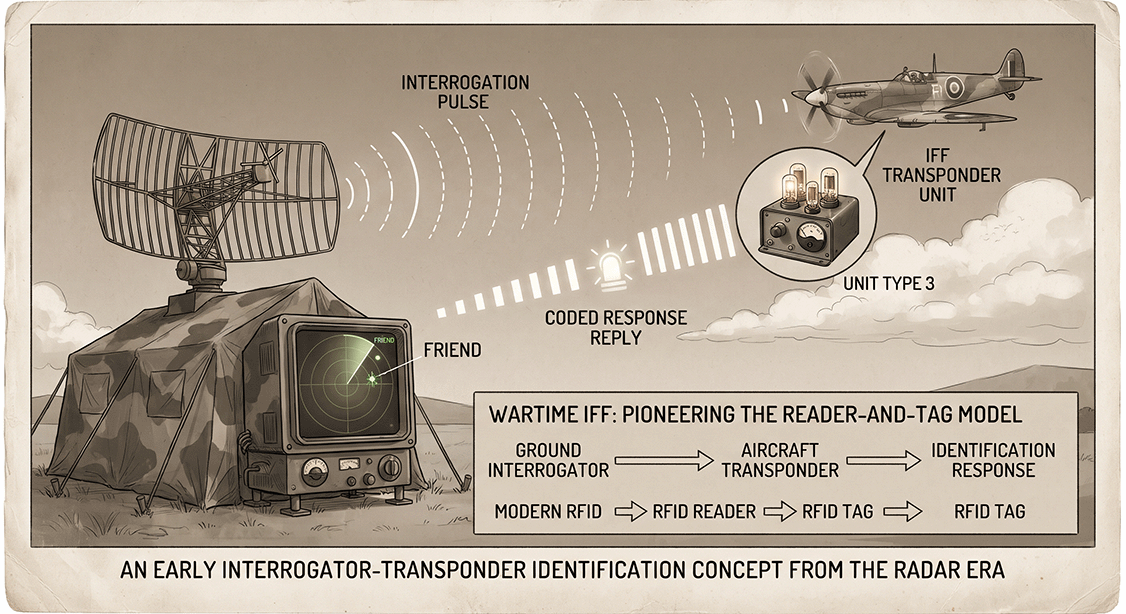
A crucial step came with wartime Identification Friend or Foe (IFF) systems. As radar let operators detect aircraft, a problem arose: distinguishing friendly aircraft from enemy ones on the radar screen. IFF systems addressed this by equipping friendly aircraft with transponders that, when interrogated by a signal, responded to identify themselves as friendly. This was, in essence, an early application of the core RFID concept: a reader (the interrogating system) querying a transponder (on the aircraft) that responds with identifying information. IFF demonstrated the practical value of wireless identification — using radio signals not just to detect but to identify. This wartime use established the interrogator-transponder model at the heart of RFID. Understanding that IFF systems pioneered the concept of a transponder responding to interrogation with identification shows the direct conceptual ancestor of modern RFID, where the wartime need to identify aircraft via radio created the reader-and-tag model that underlies how RFID systems work today.
The first transponders and patents
In the decades after the war, researchers and inventors developed the concepts that would become RFID. Work explored how transponders could store and return information, how passive devices might draw power from a signal, and how identification could be encoded and read. Key patents in this era established foundational concepts of RFID — passive transponders, modulated backscatter (the technique by which a passive tag reflects and modulates the reader's signal to communicate), and identification systems. These developments moved RFID from the specialized wartime context toward a general identification technology. Researchers demonstrated systems that could identify objects wirelessly using these principles, proving the broader concept. Understanding that postwar research and key patents established the core mechanisms — passive transponders and backscatter communication — shows how the wartime concept was developed into the technical basis of modern RFID, with the inventions of this period creating the methods by which tags would later store identity and communicate it to readers across many applications.
Early commercial applications
RFID's first commercial uses emerged as the technology matured. Early applications included electronic article surveillance (EAS) for retail anti-theft, which used simple tags to detect items leaving a store, and access control and animal identification using low-frequency systems. These early uses, often at low frequency with short range, demonstrated RFID's commercial value in specific niches. Electronic toll collection, letting vehicles pay tolls without stopping via tags read at toll points, became a prominent early success showing RFID's potential for automated identification at scale. These applications proved that RFID could deliver real value commercially, building the foundation for broader adoption. Understanding that early commercial RFID found success in anti-theft, access control, animal ID, and toll collection shows how the technology established itself in practical niches before its later explosion, with these early applications demonstrating the commercial viability that would eventually drive RFID toward the mass adoption seen in industries today.
The rise of standards
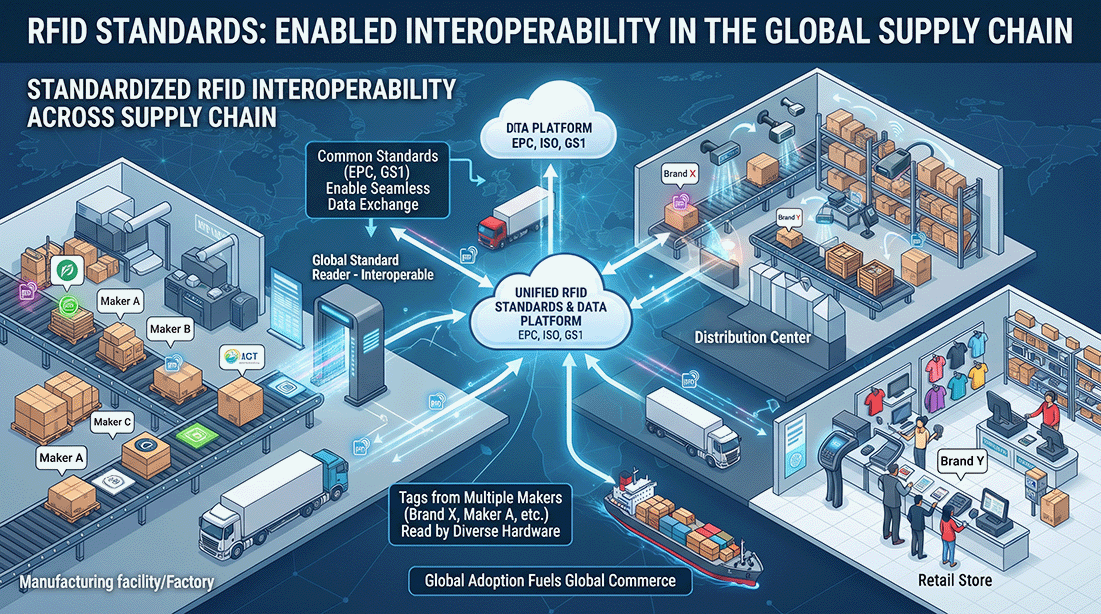
Standardization was essential to RFID's broader spread. For RFID to scale beyond proprietary niche systems, common standards were needed so that tags and readers from different makers could work together and so the technology could be adopted across supply chains spanning many companies. Organizations developed standards governing how RFID systems communicate, the data formats used, and interoperability. The development of the Electronic Product Code (EPC) and associated standards aimed to create a universal system for identifying products with RFID, enabling supply-chain-wide adoption. Standards transformed RFID from incompatible proprietary systems into an interoperable technology that companies could adopt with confidence. Understanding that standards enabled interoperability and supply-chain-scale adoption shows why standardization was a turning point, allowing RFID to spread across industries because tags, readers, and systems could finally work together, a precondition for the global commerce applications that supply chains would build on RFID.
The move to UHF and the commercial revolution
The shift to UHF RFID unlocked mass commercial adoption. Ultra-high-frequency RFID, with its longer read range and ability to read many tags quickly, suited the demands of supply chain and retail far better than earlier short-range systems. Combined with falling tag costs and the EPC Gen2 standard, UHF made item-level and pallet-level tagging economically viable at scale. Major retailers and their supply chains began adopting RFID to track inventory, driving large-scale deployment and further cost reductions. This convergence — UHF capability, standards, and low cost — sparked the commercial revolution that brought RFID into mainstream supply chain and retail use. Understanding that UHF, standards, and affordability together enabled large-scale commercial adoption explains RFID's transformation from niche technology to commercial mainstay, with the move to UHF making the high-volume, long-range reading that modern retail and logistics require both possible and affordable, driving RFID's spread through global commerce.
RFID in everyday life today
Today, RFID is woven through daily life and commerce, the culmination of its long evolution. It tracks inventory in stores and warehouses, enables contactless cards and payments, controls access to buildings, identifies animals, manages assets, and supports countless applications across industries. Billions of tags are produced annually, and the technology continues to advance with new capabilities and applications. From its wartime origins to today's ubiquity, RFID has become a foundational technology of modern commerce and life, often working invisibly behind the scenes. The journey from radar and IFF to global commerce reflects decades of innovation, standardization, and adoption. As a manufacturer part of this ongoing story, our team produces the RFID products that serve today's diverse applications. To explore how today's RFID technology can serve your needs, building on this rich history, contact our team, and discover our range of RFID products for modern applications across industries.
Frequently Asked Questions
Where did RFID technology originate?
RFID's roots lie in early twentieth-century radio research and wartime radar, which demonstrated that radio waves could detect objects at a distance. Wartime Identification Friend or Foe (IFF) systems, using transponders to identify friendly aircraft, pioneered the core interrogator-and-transponder model at the heart of RFID.
What was the first use of RFID?
Early RFID concepts grew from wartime IFF identification. The first commercial uses included electronic article surveillance for retail anti-theft, access control, animal identification, and electronic toll collection, which demonstrated RFID's value for automated wireless identification before broader adoption.
How did RFID become widespread in commerce?
Standardization — including the Electronic Product Code (EPC) and EPC Gen2 — enabled interoperability across supply chains, while the move to ultra-high frequency provided long range and fast bulk reading. Combined with falling tag costs, this convergence made large-scale retail and supply-chain adoption viable.
What is modulated backscatter?
Modulated backscatter is the technique by which a passive RFID tag communicates: rather than generating its own signal, the tag reflects and modulates the reader's radio signal to encode its data. This foundational mechanism, established in early RFID research, lets battery-free passive tags respond to readers.
How is RFID used today?
Today RFID tracks inventory in stores and warehouses, enables contactless cards and payments, controls building access, identifies animals, manages assets, and supports countless applications across industries. Billions of tags are produced annually, making RFID a foundational technology of modern commerce and daily life.
Put today's RFID technology to work
Building on decades of innovation, we manufacture the RFID products that serve modern applications across industries — from inventory and access to asset tracking and beyond.
Discuss your application Explore RFID tags