


We will cover linear versus circular polarization, near-field versus far-field, tag antenna design, reader antenna choices, gain and range trade-offs, and matching antennas to applications.
Key takeaways
- The antenna, on both tag and reader, largely determines RFID read performance.
- Linear and circular polarization suit different tag orientations and applications.
- Tag antenna design must match the frequency, item, and environment.
- Matching reader antenna gain and pattern to the application ensures reliable reads.
Linear versus circular polarization
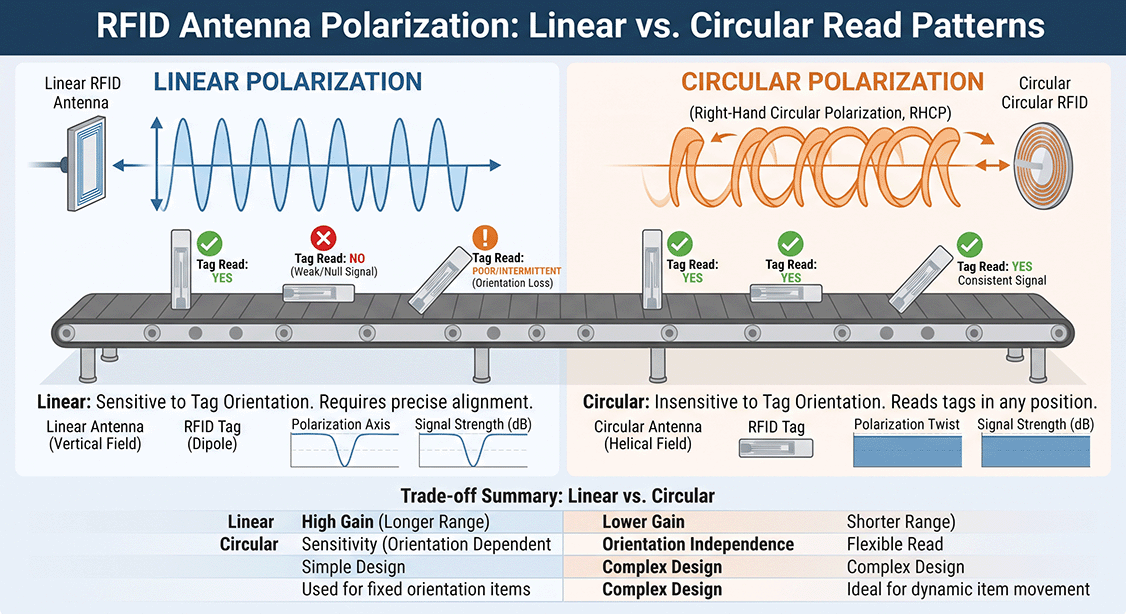
Polarization is a fundamental antenna characteristic affecting how tags are read. Linear-polarized antennas concentrate energy in a single plane, offering longer range when the tag antenna aligns with that plane, but reading poorly when the tag is oriented differently. Circular-polarized antennas radiate energy in a rotating pattern, reading tags in various orientations more reliably but with somewhat shorter range than a well-aligned linear antenna. The choice depends on whether tag orientation is controlled or variable: linear suits applications where tags pass in a known, consistent orientation and maximum range matters, while circular suits applications where tags arrive in unpredictable orientations and reliable reading regardless of angle is more important than peak range. Understanding this trade-off between range and orientation tolerance guides antenna selection. For many real-world applications where tag orientation varies, circular polarization's reliability across orientations is valuable, while controlled applications may benefit from linear polarization's range, making polarization a key consideration in matching antennas to how tags will actually present in your application.
Near-field versus far-field
Near-field and far-field describe two regimes of RFID operation with different antenna behavior. Near-field operation works at very short range using magnetic coupling, suited to applications reading tags very close to the antenna, and is relevant for certain HF and specialized UHF applications requiring short, controlled read zones. Far-field operation works at longer range using radiated electromagnetic waves, the regime of typical UHF RFID reading tags from a distance. The antenna design differs for near-field versus far-field operation, and the choice depends on the required read range and zone. Applications needing tags read only when very close benefit from near-field designs that limit range and provide controlled reading, while applications needing distance use far-field. Understanding which regime suits your application — short controlled reads versus longer-range reading — guides the antenna approach. For most UHF applications reading at distance, far-field operation applies, while specialized short-range needs may use near-field designs, making the near-field versus far-field distinction important for applications with specific read-zone requirements.
Tag antenna design
The tag antenna — the conductive pattern that collects energy and radiates the response — is critical to tag performance and must suit the frequency, item, and environment. Tag antennas are designed for specific frequency bands, with the size and shape tuned to the wavelength, so a UHF tag antenna differs from an HF one. The antenna design also affects how the tag performs on different materials and in different environments, which is why specialized tags exist for challenging surfaces. The item the tag goes on, the surrounding materials, and the read requirements all influence the appropriate tag antenna design. A well-designed tag antenna matched to the application reads reliably, while a poorly matched one underperforms. This is why tag selection matters so much: the embedded antenna must suit the use. Understanding that the tag antenna design must match the frequency, item, and environment explains why choosing the right tag for the application is essential, since the antenna inside each tag fundamentally determines how well it performs in its specific deployment conditions and on its intended surface.
Antennas for challenging materials
Difficult materials like metal and liquids affect antenna performance, requiring specialized designs. Metal reflects and detunes ordinary tag antennas, and liquids absorb RF energy, both degrading reads. Tags for these environments use antenna designs engineered to work despite the challenging material — anti-metal tags incorporate designs and spacing that allow reliable operation on metal surfaces, and tags for liquid-adjacent use are designed to cope with absorption. The antenna engineering in these specialized tags is what allows RFID to work where ordinary tags fail. For applications involving metal assets, liquid containers, or other difficult materials, selecting tags with antennas designed for those conditions is essential to reliable performance. Understanding that challenging materials require specialized antenna designs explains why general-purpose tags fail on metal or near liquid while purpose-designed tags succeed. Choosing tags whose antenna design suits the challenging materials in your application ensures reliable reads where ordinary antennas would be detuned or absorbed, making material-appropriate antenna design critical for demanding environments.
Reader antenna choices
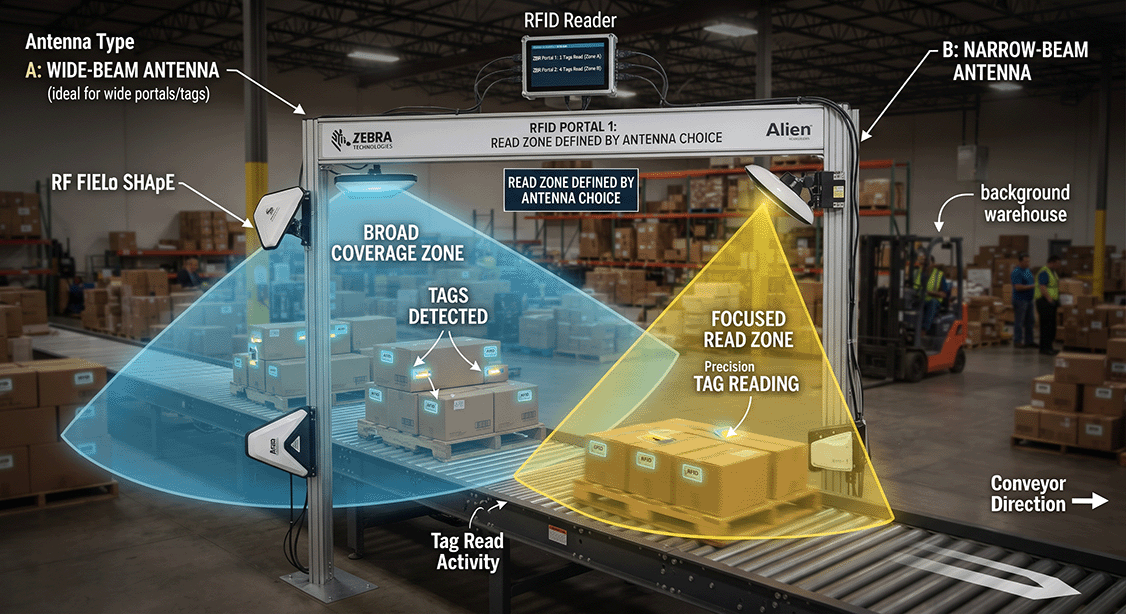
Reader antennas — separate from or integrated with the reader — shape the read zone and must suit the application. Reader antennas vary in gain, beam pattern, polarization, and form factor. Higher-gain antennas concentrate energy for longer range over a narrower area, while lower-gain antennas cover a wider area at shorter range. The beam pattern determines the shape and coverage of the read zone, and polarization affects orientation tolerance as discussed. Choosing reader antennas means matching these characteristics to the application: the read zone size and shape needed, the range required, and the tag orientations expected. The right reader antenna creates a read zone that reliably captures tags where needed without excessive reading outside the intended area. For installations like portals, conveyors, or fixed read points, selecting appropriate reader antennas is essential to defining an effective read zone. Understanding reader antenna characteristics — gain, pattern, polarization, form factor — and matching them to the application ensures the reading infrastructure creates the read zone the deployment requires for reliable tag capture.
Gain, range, and trade-offs
Antenna gain involves trade-offs central to antenna selection. Higher gain provides longer range and stronger reads but over a narrower, more directional area, while lower gain covers a broader area at shorter range. There is no universally best gain; the right choice depends on whether the application needs concentrated range over a specific zone or broader coverage. Similarly, the trade-offs between range, read-zone size, orientation tolerance, and avoiding unwanted reads of nearby tags all factor into antenna selection. Optimizing for the application means balancing these factors: enough range and coverage to read intended tags reliably, without so much that stray tags are read or the zone is mis-shaped. Understanding these trade-offs prevents the mistake of simply maximizing one parameter at the expense of others. The art of antenna selection lies in balancing gain, range, coverage, and orientation tolerance for the specific application, achieving reliable reads of the right tags in the right zone, which thoughtful antenna selection delivers by matching antenna characteristics to the actual read requirements rather than chasing a single specification.
Matching antennas to your application
Matching antennas to the application brings these considerations together. Consider the frequency band, the tags' orientation and movement, the read range and zone needed, the materials involved, and the environment, then select tag and reader antennas suited to these factors. A controlled conveyor application with consistent tag orientation differs from a portal with tags in random orientations, which differs again from reading metal assets — each calls for different antenna choices. Getting the antenna selection right, for both tags and readers, is often the difference between an RFID system that performs reliably and one that struggles. As a manufacturer of RFID tags with antennas designed for various frequencies, materials, and applications, our team helps customers select tags whose antenna design suits their use, and advises on the overall antenna approach. Matching the right antennas to your application is essential to RFID performance, and getting expert guidance ensures the choice fits your needs. To select tags and discuss the antenna approach for your application, contact our team.
Frequently Asked Questions
What is the difference between linear and circular polarized RFID antennas?
Linear-polarized antennas concentrate energy in one plane, offering longer range when the tag aligns with that plane but reading poorly otherwise. Circular-polarized antennas radiate in a rotating pattern, reading tags in various orientations more reliably but with somewhat shorter range. Linear suits controlled orientations; circular suits variable ones.
Why do metal and liquids affect RFID antennas?
Metal reflects and detunes ordinary tag antennas, and liquids absorb RF energy, both degrading reads. Tags for these environments use specialized antenna designs — anti-metal tags incorporate spacing and designs for metal surfaces, and liquid-adjacent tags cope with absorption — allowing reliable operation where ordinary antennas fail.
How does reader antenna gain affect performance?
Higher-gain antennas concentrate energy for longer range over a narrower, more directional area, while lower-gain antennas cover a wider area at shorter range. The right choice depends on whether the application needs concentrated range over a specific zone or broader coverage, balancing range against coverage.
Does the tag antenna design matter?
Very much. The tag antenna collects energy and radiates the response, and must suit the frequency band, the item it goes on, and the environment. A UHF tag antenna differs from an HF one, and the design affects performance on different materials, which is why choosing the right tag for the application is essential.
How do I choose the right RFID antenna for my application?
Consider the frequency band, tag orientation and movement, read range and zone needed, materials involved, and environment, then select tag and reader antennas suited to these factors. A controlled conveyor differs from a random-orientation portal or metal-asset reading, each calling for different antenna choices.
Match the right antenna to your application
We design RFID tags with antennas suited to different frequencies, materials, and applications, and advise on the overall antenna approach — so your system reads reliably where it matters.
Discuss your application Explore RFID tags