


We will cover how each works, range and coverage, indoor versus outdoor, cost and power, real-time versus checkpoint tracking, and how to choose or combine them.
Key takeaways
- RFID identifies assets at read points; GPS provides continuous outdoor location.
- RFID works indoors and out at read points; GPS needs outdoor satellite signals.
- Passive RFID tags are cheap and need no power; GPS trackers need power.
- The right choice depends on whether you need checkpoint identification or real-time location.
How each technology works
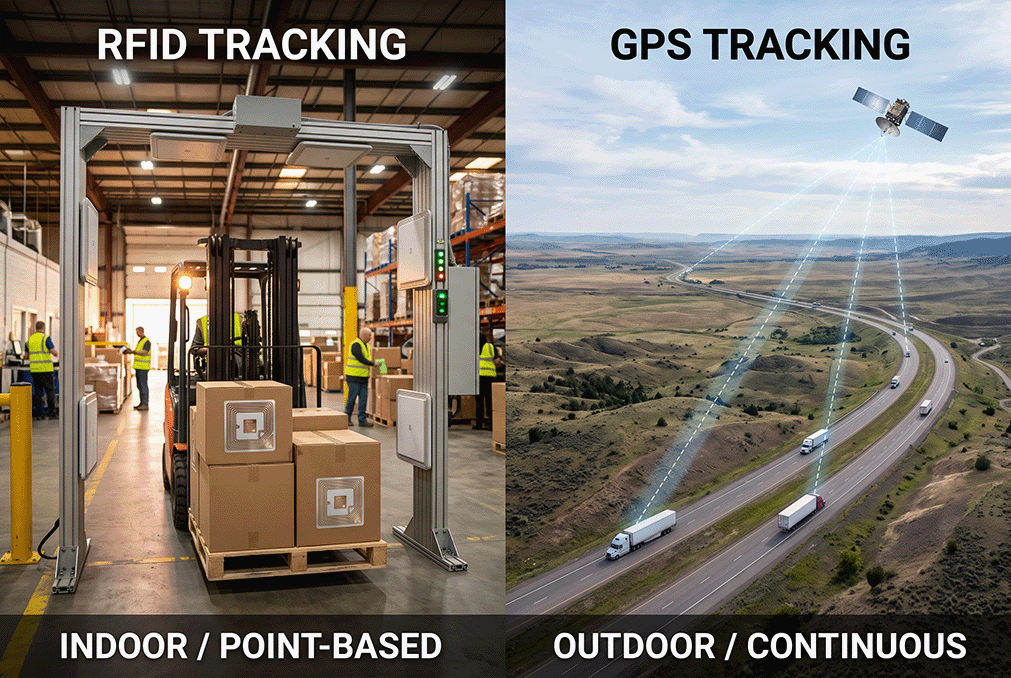
RFID and GPS work in fundamentally different ways. RFID uses tags read by readers at specific locations — an asset is identified when it passes a reader, recording that it was at that point at that time. RFID provides identification at read points, not continuous location. GPS, by contrast, uses satellite signals received by a GPS device on the asset to determine its location anywhere with a clear sky view, providing continuous, real-time position. So RFID tells you an asset was read at a known point, while GPS tells you exactly where an asset is at any moment. This fundamental difference — checkpoint identification versus continuous location — underlies all the others. Understanding that RFID identifies assets at read points while GPS continuously locates them anywhere outdoors explains the core distinction, where RFID answers where an asset was last read among known points and GPS answers where an asset is right now, two different questions that suit different tracking needs.
Range and coverage
Range and coverage differ greatly. RFID has limited range — assets are read when near a reader, so coverage exists only where readers are placed. RFID tracks assets through known points (gates, doorways, checkpoints) rather than everywhere. GPS provides location anywhere with satellite signal coverage, which is essentially anywhere outdoors with a sky view, giving broad geographic coverage without needing infrastructure at each location. So RFID provides point-based tracking within a controlled area where readers exist, while GPS provides location across wide outdoor areas. For tracking assets within a facility or through defined points, RFID's coverage suffices; for tracking assets across wide outdoor areas, GPS provides the coverage. Understanding that RFID covers defined read points while GPS covers wide outdoor areas explains the coverage difference, where RFID suits tracking within facilities and through checkpoints and GPS suits tracking assets across broad outdoor geographies, each providing the coverage its tracking model implies.
Indoor versus outdoor
Indoor and outdoor performance is a key differentiator. RFID works both indoors and outdoors at read points, making it well suited to indoor environments — warehouses, facilities, buildings — where it tracks assets through readers regardless of being inside. GPS requires a clear view of the sky to receive satellite signals and generally does not work well indoors, where signals are blocked. So for indoor tracking, RFID is suitable while GPS is limited, and for outdoor location across wide areas, GPS excels. This makes RFID the choice for indoor and facility-based tracking, and GPS the choice for outdoor location tracking. The indoor-outdoor distinction often determines which technology fits an application. Understanding that RFID works indoors at read points while GPS needs outdoor sky view explains a decisive factor, where indoor and facility tracking favor RFID and wide outdoor location tracking favors GPS, the environment frequently pointing to the appropriate technology for a tracking use case.
Cost and power considerations
Cost and power differ substantially. Passive RFID tags are inexpensive and need no power source — they draw energy from readers — making it economical to tag many assets, with cost concentrated in the reader infrastructure. GPS trackers are more expensive per unit and require power, typically batteries that must be maintained or charged, since the device actively receives signals and transmits location. So tagging many assets with passive RFID is cheap and maintenance-free per tag, while equipping assets with GPS trackers costs more per asset and involves power management. For tracking many low-value items, RFID's low per-tag cost suits; for tracking fewer high-value assets needing location anywhere, GPS's per-unit cost may be justified. Understanding that passive RFID tags are cheap and powerless while GPS trackers cost more and need power explains the economic difference, where the low cost of tagging many assets with RFID contrasts with the higher per-unit cost and power needs of GPS, influencing which suits an application's scale and asset value.
Real-time location versus checkpoint identification
The kind of tracking each provides is the crux. GPS provides real-time, continuous location — you always know where an asset is, useful for tracking vehicles or assets in transit where current location matters. RFID provides checkpoint identification — you know an asset was read at a point at a time, useful for knowing assets passed through stages, entered or left areas, or are present in a facility, but not their continuous whereabouts between reads. So if you need to know exactly where an asset is at any moment, GPS provides it; if you need to know assets passed defined points or are present in an area, RFID provides it. This distinction often determines the choice based on what you need to know. Understanding that GPS gives continuous real-time location while RFID gives checkpoint identification clarifies the choice, where needing current location points to GPS and needing to track movement through points or presence in areas points to RFID, the nature of the tracking required guiding the decision.
How to choose — or combine — them
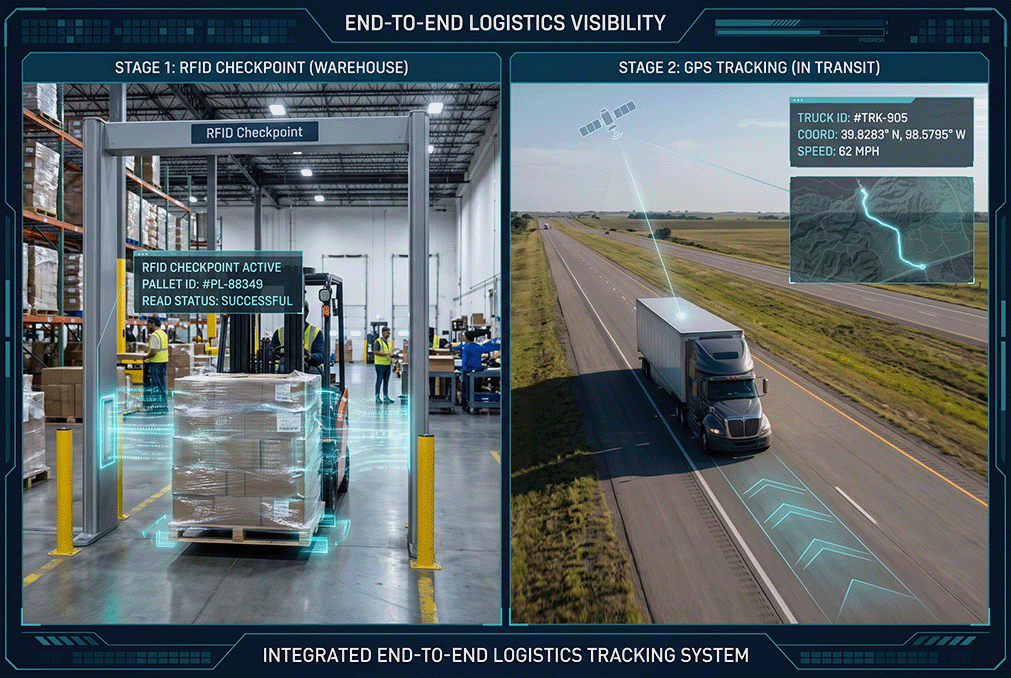
Choosing depends on your tracking needs. Choose RFID for indoor and facility tracking, tracking assets through defined points, tagging many items affordably, and knowing presence and movement through stages. Choose GPS for real-time outdoor location, tracking vehicles or assets across wide areas, and knowing exactly where assets are at any moment. For some needs, combining both makes sense: RFID for checkpoint and facility tracking and GPS for location in transit, achieving comprehensive end-to-end visibility. Assessing what you need to know about your assets, where they are, and your constraints guides the choice. Many asset-tracking solutions use the technology — or combination — that fits the specific need. As a manufacturer of RFID tags for asset tracking, our team helps customers determine where RFID fits their tracking needs, alone or alongside other technologies. To explore RFID for asset tracking, contact our team for tags suited to your facility, checkpoint, and asset-tracking needs.
Frequently Asked Questions
What is the difference between RFID and GPS tracking?
RFID identifies assets at read points — telling you an asset passed a specific location at a time — while GPS provides continuous real-time location anywhere outdoors. RFID gives checkpoint identification within areas where readers exist; GPS gives location across wide outdoor geographies. They answer different tracking questions.
Is RFID or GPS better for indoor tracking?
RFID is better for indoor tracking. It works both indoors and outdoors at read points, suiting warehouses, facilities, and buildings where it tracks assets through readers. GPS requires a clear sky view for satellite signals and generally does not work well indoors, where signals are blocked.
Which is cheaper, RFID or GPS?
Passive RFID tags are inexpensive and need no power, making it economical to tag many assets, with cost concentrated in reader infrastructure. GPS trackers cost more per unit and need power. For tracking many low-value items, RFID is cheaper; for fewer high-value assets needing location anywhere, GPS may be justified.
Does RFID provide real-time location?
Not continuously. RFID provides checkpoint identification — you know an asset was read at a point at a time, and its presence or movement through defined points, but not its continuous whereabouts between reads. For real-time continuous location, GPS is the technology that provides it anywhere outdoors.
Can RFID and GPS be used together?
Yes. Combining them can make sense — RFID for checkpoint and facility tracking and GPS for location in transit — achieving comprehensive end-to-end visibility neither provides alone. Many asset-tracking solutions use the technology or combination that fits the specific tracking need.
Find where RFID fits your tracking needs
As a manufacturer of RFID tags for asset tracking, we help you determine where RFID serves your facility, checkpoint, and asset-tracking needs — on its own or alongside other technologies.
Discuss your tracking project Explore RFID tags