


We will cover how each works, line-of-sight versus bulk reading, speed and labor, durability, cost, data capacity, and how to choose.
Key takeaways
- QR codes are cheap and smartphone-readable but require line-of-sight, one-at-a-time scanning.
- RFID reads many items at once without line of sight, far faster for bulk operations.
- RFID costs more per item and needs readers; QR codes print nearly free.
- The right choice depends on volume, speed needs, durability, and budget.
How each technology works
QR codes and RFID identify items through fundamentally different mechanisms. A QR code is a printed two-dimensional barcode that a camera or scanner reads optically, decoding the pattern to retrieve the encoded data — it requires the scanner to see the code clearly, one code at a time. RFID uses a chip and antenna that communicate with a reader via radio waves, allowing reading without line of sight and reading many tags simultaneously. So QR codes are an optical, line-of-sight, one-at-a-time technology readable by ubiquitous smartphones, while RFID is a radio-based, no-line-of-sight, bulk-reading technology requiring RFID readers. These different mechanisms underlie all the practical differences between them. Understanding that QR codes are read optically one at a time while RFID is read via radio in bulk clarifies the fundamental distinction that shapes their suitability for different inventory tasks. The optical-versus-radio difference between QR codes and RFID is the root of their contrasting strengths in inventory management, determining how each performs in practice.
Line-of-sight versus bulk reading
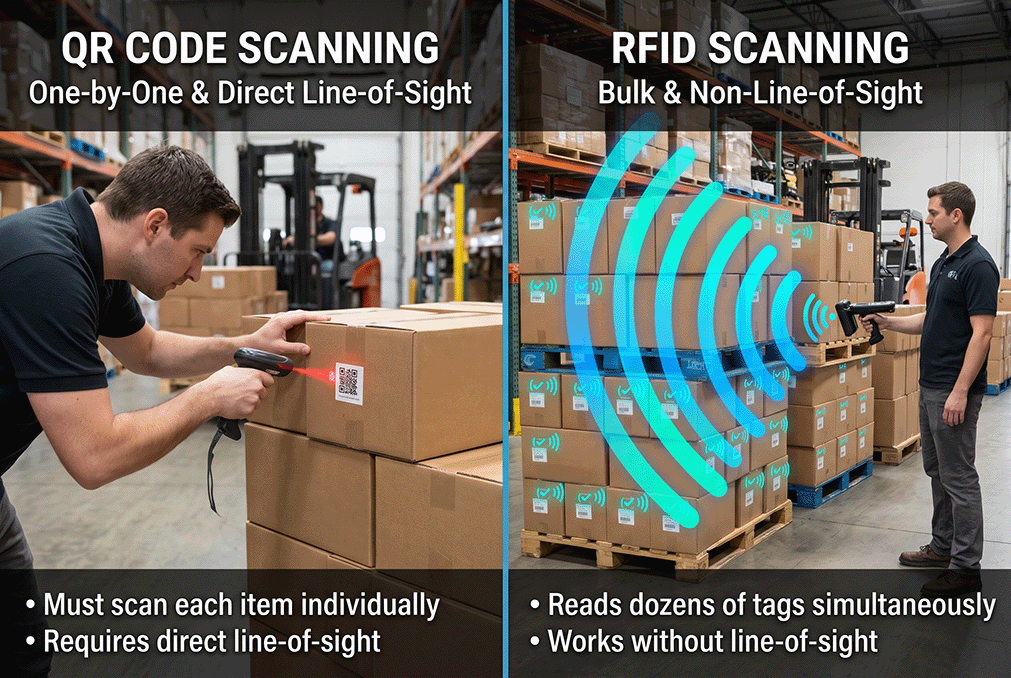
The defining difference for inventory is line-of-sight versus bulk reading. QR codes must be individually visible to the scanner and scanned one at a time, so counting many items means scanning each code separately, which is slow for large inventories. RFID reads many tags at once without needing to see them, so an RFID reader can count many tagged items rapidly, even inside boxes or stacked, without individual handling. This difference is decisive for bulk inventory operations: RFID's ability to read many items simultaneously without line of sight makes it dramatically faster for counting large quantities, while QR codes' one-at-a-time scanning is manageable for small numbers but slow at scale. For inventory management involving many items, this bulk-reading capability is RFID's signature advantage. Understanding that QR codes require line-of-sight, one-at-a-time scanning while RFID reads many items at once without line of sight explains RFID's speed advantage for bulk inventory, the most consequential difference between the technologies for inventory operations at scale.
Speed and labor
Speed and labor follow directly from the reading difference. Because RFID reads many items at once, it dramatically reduces the time and labor of inventory counts compared to scanning QR codes individually. A count that takes hours scanning QR codes one by one can take a fraction of the time with RFID reading in bulk. This labor saving is a major reason operations adopt RFID for inventory, as the recurring time savings accumulate. QR codes, while slower for bulk counting, require no special reader beyond a smartphone and suit operations where the volume is manageable or scanning is occasional. For high-volume or frequent inventory operations, RFID's speed and labor advantages are compelling, while for lower-volume or occasional needs, QR codes' simplicity may suffice. Understanding that RFID's bulk reading saves substantial time and labor versus one-at-a-time QR scanning explains its appeal for inventory-intensive operations, where the speed and labor benefits, accumulating over many counts, often justify the greater cost, while QR codes remain practical for lighter inventory needs.
Durability and environment
Durability differs between printed QR codes and RFID tags. A QR code is a printed pattern that must remain clean, undamaged, and visible to scan — if it is dirty, torn, faded, or obscured, it may not read. RFID tags, especially in durable forms, can withstand harsher conditions and read even when not visible, and specialized tags handle demanding environments. For inventory in clean, controlled conditions where labels stay legible, QR codes' durability may be adequate, while for harsh environments, outdoor use, or conditions that damage printed labels, RFID's durability options offer an advantage. The environment thus influences the choice: printed QR codes suit benign conditions, while RFID suits demanding ones or where labels would be obscured. Understanding that printed QR codes require a clean, visible, undamaged surface while RFID can be more durable and read without visibility shows how the environment affects suitability. For inventory in conditions that challenge printed labels, RFID's durability and no-line-of-sight reading provide reliability that QR codes may not, while benign conditions may suit either.
Cost and data capacity
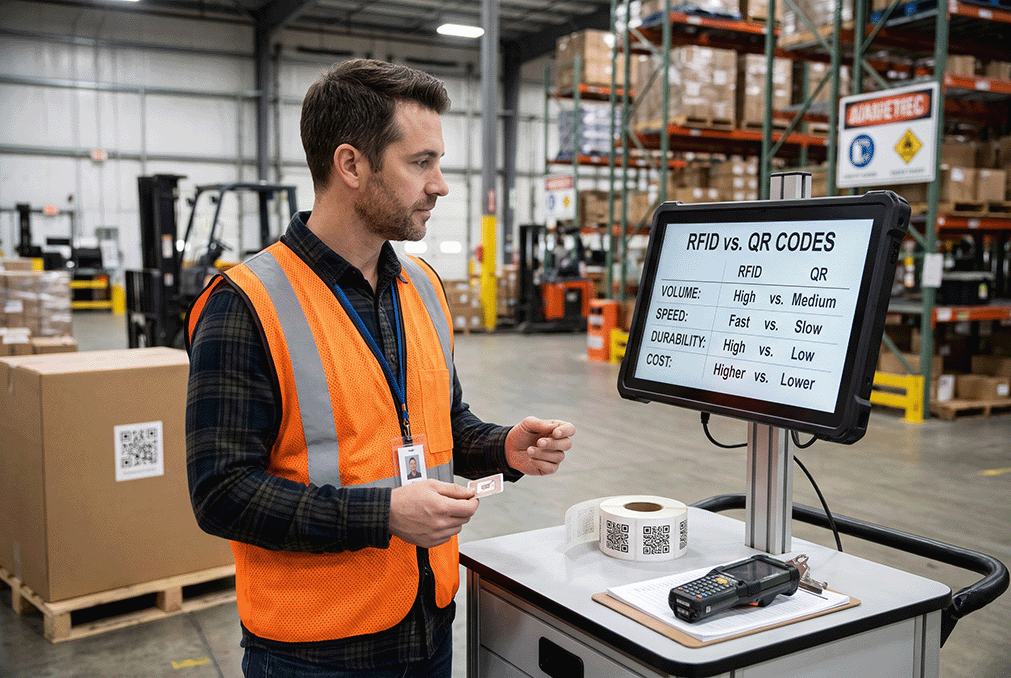
Cost is a key QR-code advantage, while data capacity favors both in different ways. QR codes are extremely inexpensive — printed with ordinary printers at negligible per-item cost — and readable by smartphones everyone has, giving them a major cost advantage, especially for high volumes of items. RFID tags cost more per item and require RFID readers, a higher cost that the speed and labor benefits must justify. On data, QR codes can hold a useful amount of data in the printed code, while RFID chips store data and can be updated, with capacity varying by chip. For cost-sensitive applications with manageable volume, QR codes' low cost is compelling, while for operations where RFID's speed justifies the cost, the investment pays off. Understanding that QR codes are far cheaper and smartphone-readable while RFID costs more but reads in bulk frames the central cost trade-off. The cost advantage of QR codes versus the speed advantage of RFID is often the crux of the decision, weighed against the operation's volume and speed needs.
How to choose — or combine
The right choice depends on your inventory needs, and sometimes both technologies serve. Choose RFID when bulk reading speed, no-line-of-sight reading, durability, or high-volume frequent counting matters, and the benefits justify the cost. Choose QR codes when cost sensitivity, smartphone readability, manageable volume, or simplicity matters, and line-of-sight scanning is acceptable. Some operations use both — RFID where its speed and capability are needed, QR codes where their low cost and ubiquity suffice — applying each where it fits best. Clarifying your priorities, volume, environment, and budget points to the right choice or combination. Neither technology is universally superior; each excels in different inventory situations. As a manufacturer of RFID products, our team helps businesses determine where RFID's advantages justify its use for their inventory, and where simpler approaches suffice. Understanding the trade-offs lets you choose RFID, QR codes, or both for your inventory management. To discuss whether RFID suits your inventory needs, contact our team for guidance grounded in your operation's volume, environment, and goals.
Frequently Asked Questions
What is the main difference between RFID and QR codes for inventory?
QR codes are printed two-dimensional barcodes read optically, one at a time, requiring line-of-sight, and readable by smartphones. RFID uses a chip and antenna read via radio, allowing many tags to be read at once without line of sight. This optical-versus-radio difference shapes all their practical distinctions.
Is RFID faster than QR codes for inventory counts?
Yes, substantially. Because RFID reads many tagged items at once without line of sight, a count that takes hours scanning QR codes individually can take a fraction of the time with RFID. This speed and labor advantage is a primary reason operations adopt RFID for high-volume inventory.
Are QR codes cheaper than RFID?
Yes. QR codes are printed with ordinary printers at negligible per-item cost and read by smartphones everyone has, giving a major cost advantage especially at high volume. RFID tags cost more per item and require RFID readers, a higher cost that the speed and labor benefits must justify.
Which is more durable, RFID or QR codes?
RFID tags, especially durable forms, generally withstand harsher conditions and read even when not visible, while printed QR codes must stay clean, undamaged, and visible to scan. For harsh environments or conditions that damage labels, RFID offers durability advantages; benign conditions may suit QR codes.
Can I use both RFID and QR codes?
Yes. Many operations use RFID where its bulk-reading speed, no-line-of-sight reading, and durability are needed, and QR codes where their low cost and smartphone readability suffice, applying each technology where it fits best for different items or processes within the same operation.
Find the right inventory technology
We help businesses determine where RFID's bulk-reading speed and durability justify its use — and where simpler approaches suffice — for inventory management grounded in your real needs.
Discuss your inventory needs Explore RFID tags