


This article is therefore about logistics rather than technology. It assumes you know what event tags do and covers what it takes to make them work once, on a fixed date, in a building you do not control.
Key takeaways
- Encode and verify every tag before it leaves the office, never at the venue.
- Assume no signal in the hall; build a payload that survives it.
- Two thousand people will tap within the same ten minutes.
- Decide before the event who deletes the attendee data, and when.
Encode before you get there
The venue is the worst place to do anything. Encoding tags requires a computer, a reader, a quiet surface, a reliable list, and time — four of which are unavailable in a hall on the morning of a show. Encode, lock where appropriate, and read-verify every tag in the office, against a manifest that records which tag carries which link. Label the back of each tag with its destination in plain text so a person under pressure can find the right one. Bring twenty per cent spares, already encoded, because tags will be lost, stuck to the wrong surface, or destroyed by a fork-lift. Bring the reader anyway, and the laptop, because something will need re-encoding and it is better to have carried them for nothing. Understanding that the venue is for installing tags and not for making them, and that verification happens where the light is good, prevents the failure that ruins the morning.
Assume the hall has no signal
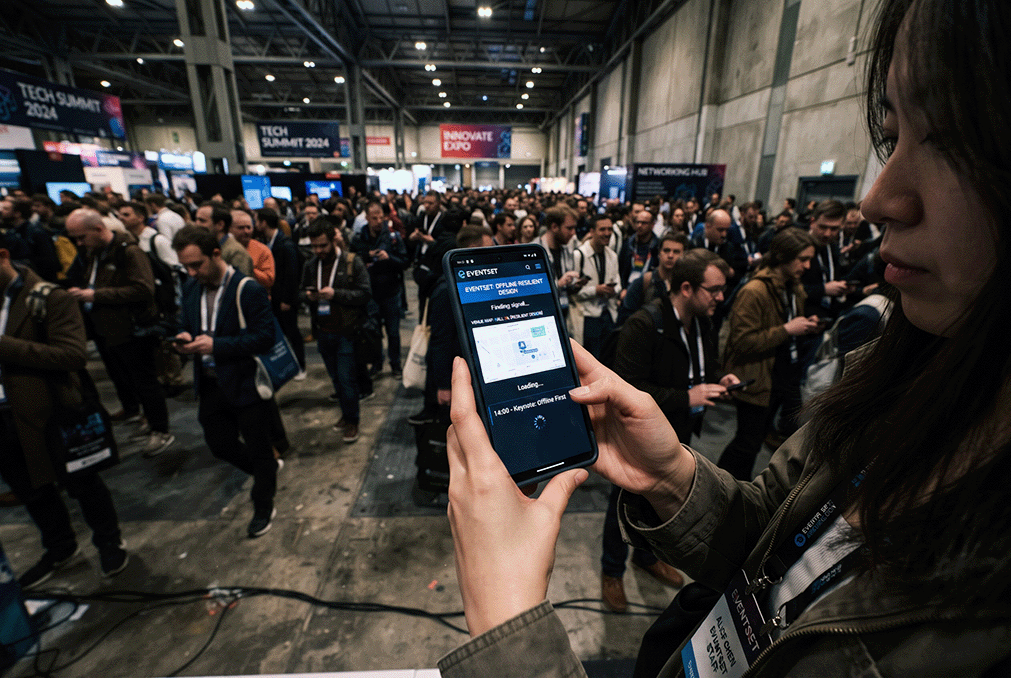
Exhibition halls are Faraday cages full of people. Steel, concrete, thousands of phones, and a mobile network provisioned for an empty building. The tap will work — NFC needs no network — but the page behind it may not load, and a payload that requires a fast connection is a payload that will fail at the moment it is watched by the most people. Design accordingly. Keep pages tiny; deliver the single valuable thing first; encode critical information as plain text in the tag itself where it will fit, so a session time, a stand number, or a code exists even with no data at all. Ask the venue for its Wi-Fi terms early, and disbelieve the answer. And rehearse the payload on the venue's own network, in the hall, at the time of day the doors open. Understanding that connectivity is the event's most likely single point of failure — and that a venue will not fix it for you — is what separates a working stand from a queue of people staring at spinners.
The hour in which everything is installed
Installation is a timed operation. Between the stand being finished and the doors opening there is usually one hour, sometimes less, and in it a small number of people must place, stick, test, and mark every tag. Plan it like a checklist: a printed map of tag locations, a named person per zone, a phone per person for verification, and adhesive suitable for the actual surfaces — which will be melamine, painted steel, glass, fabric, and a plinth nobody mentioned. Metal surfaces need on-metal tags and are always discovered late. Test every tag after it is stuck, not before, because a tag that read on a table may not read on a steel upright. Mark each tap point visibly at a reachable height. Photograph the finished installation. Understanding that the install window is short, unrepeatable, and staffed by people who did not encode the tags is why the manifest, the map, and the spares matter more than the specification.
Everybody taps at once
A load spike is guaranteed. Attendance is not evenly distributed: doors open, a keynote ends, a session breaks, and two thousand people move at once. A tag beside a popular exhibit may be tapped several hundred times in ten minutes, and the page behind it, the short-link service, the consent capture, and any lead-capture database will all be hit simultaneously by an audience that will not wait. Load-test the whole chain at the peak rate you actually expect, not the average, and include the redirect service — a link shortener with a rate limit will silently drop taps at exactly the wrong moment. Build the page so a failed backend still returns something useful. Understanding that event traffic is a spike and not a stream, and provisioning for the spike, is a straightforward engineering task that is almost never done.
Staff, consent, and the person hired that morning
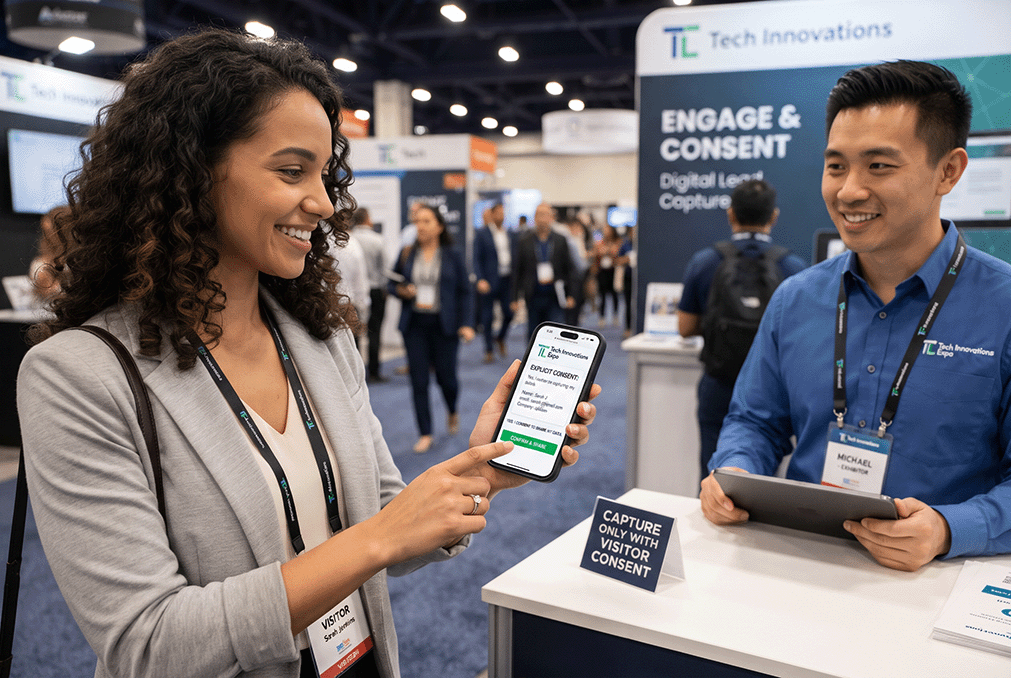
Casual staff are the interface. The people standing beside the tags will frequently have been hired for the week, briefed for fifteen minutes, and given no context. Write them one sentence to say, one thing to do if a phone will not tap, and one instruction about what they must never promise. Where a tap captures a visitor's contact details, the consent must be a deliberate act on the visitor's own phone, with plain words about who will contact them and about what — never a clipboard, never a checkbox somebody else ticks, and never a prize draw whose entry condition is buried. Give the visitor something immediately in return: the specification, the demo, the recording. Understanding that consent at an event is captured by tired strangers on behalf of your brand, and must therefore be designed to be impossible to do wrongly, is what keeps a lead list lawful and usable, whether the tap is on a stand, a badge, or a wristband.
The day after
An event generates data and then abandons it. Decide, before the doors open, who owns the attendee records, where they are stored, who may access them, what the retention period is, and who will delete them — with a name and a date, not a policy. Decide too what happens to the tags: many are reusable, and a wristband or a stand tag re-encoded for the next show costs a fraction of new stock, provided somebody collects them. Export and reconcile the data within a week, while the people who ran the stand can still explain the anomalies. Send whatever you promised the visitors, quickly, because a follow-up that arrives three weeks later reads as a purchased list. Understanding that the day after the event is part of the programme — and putting a name against every post-event task before the event happens — is the difference between a lead list and a compliance problem in a spreadsheet nobody owns.
Getting started
To get started, write the tag manifest first: every tag, its location, its link, its surface. Encode, lock, and verify in the office; bring twenty per cent spares. Build a tiny page that survives no signal, and load-test the whole chain at peak. Print a map, name a person per zone, and carry on-metal tags for the surfaces nobody mentioned. Rehearse in the hall if you can, at the hour the doors open. Assign the post-event deletion to a person, by name, before the show. As a manufacturer of NFC tags, wristbands, and printed labels, our team encodes, verifies, and ships event tags to a deadline. To prepare for an event, contact our team.
Frequently Asked Questions
Why should tags be encoded before the venue?
Because encoding needs a computer, a reader, a quiet surface, a reliable list, and time, and none of these exist in a hall on show morning. Encode, lock where appropriate, and read-verify every tag in the office against a manifest recording which tag carries which link. Label each tag's back with its destination in plain text so a person under pressure finds the right one. Bring twenty per cent spares — tags get lost, misapplied, and destroyed — and bring the reader anyway.
What happens to connectivity in an exhibition hall?
It collapses. Steel, concrete, thousands of phones, and a network provisioned for an empty building. The tap itself works, because NFC needs no network, but the page behind it may not load — and it will fail when the most people are watching. Keep pages tiny, deliver the single valuable thing first, and encode critical text such as a session time or stand number into the tag itself. Ask the venue about Wi-Fi early, disbelieve the answer, and rehearse on their network in the hall.
How should tag installation be planned?
As a timed operation. Between the stand being finished and doors opening there is about an hour. Bring a printed map of tag locations, name a person per zone, give each a phone for verification, and carry adhesives for melamine, painted steel, glass, fabric, and the plinth nobody mentioned. Metal surfaces need on-metal tags and are always discovered late. Test every tag after it is stuck, not before — a tag that read on a table may fail on a steel upright — then mark each tap point and photograph the result.
What is the load spike, and how do I survive it?
Doors open, a keynote ends, a session breaks, and two thousand people move at once. A tag beside a popular exhibit may be tapped hundreds of times in ten minutes, hitting the page, the short-link service, the consent capture, and the lead database simultaneously. Load-test the whole chain at the peak rate you expect, not the average, and include the redirect service — a link shortener with a rate limit will silently drop taps at exactly the wrong moment. Ensure a failed backend still returns something useful.
How should consent be captured at an event?
As a deliberate act on the visitor's own phone, with plain words about who will contact them and about what. Never a clipboard, never a checkbox someone else ticks, and never a prize draw with a buried entry condition. Give the visitor something immediately in return — the specification, the demo, the recording. Remember that the staff beside the tags were often hired for the week and briefed for fifteen minutes, so the flow must be impossible to do wrongly. Then name the person who will delete the data, and the date.
Prepare event tags to a deadline
We encode, lock, verify, and ship NFC event tags, wristbands, and labels against your manifest — including on-metal constructions for the steel uprights nobody mentioned.
Discuss event tags See NFC tags