


This article takes the dwell time as the design constraint and works outwards: what the payload must deliver, what it must never ask for, what to do about connectivity, and the mundane physical reason most poster taps never happen at all.
Key takeaways
- Design the payload to pay off inside the wait she is already having.
- A stranger owes you nothing: never demand identity, an app, or a login.
- Public connectivity is bad; the page must be tiny and degrade gracefully.
- Most poster taps fail because the tag is behind glass or above head height.
The wait is the whole opportunity
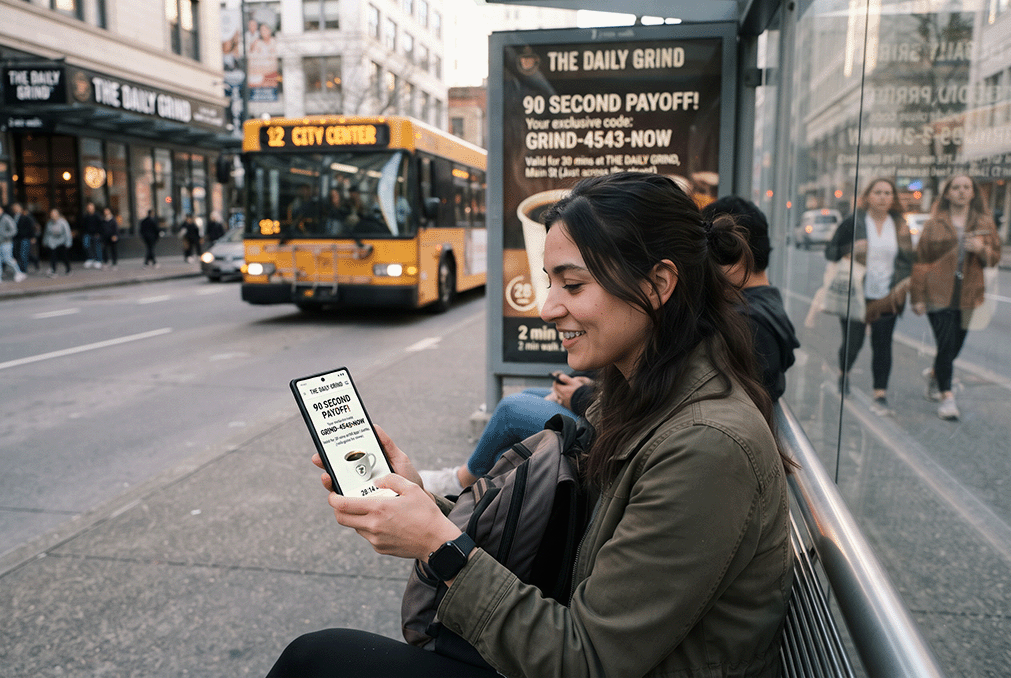
Dwell time decides what is possible. Somebody with ninety seconds can watch nothing, read a little, tap once, and leave with one thing. That rules out a video, a form, a catalogue, and an app install. It rules in a small number of payloads that complete inside the wait: a discount code that will still exist when she reaches the shop; a timetable or a route to the place the poster is advertising; a single-tap add-to-calendar for an event, with the location already filled; an audio track or a two-minute podcast episode she can start now and finish on the train; a text summary of exactly the thing the poster promised. The test is brutal and simple: can she leave the interaction better off than she arrived, without giving anything up, before her bus comes? Understanding that the poster tag competes with a phone she was already holding — and must win in the time she was already spending — is what makes the difference between a two per cent tap rate and a dead tag.
She owes you nothing, so ask for nothing
Anonymity is not a concession; it is the design. Every request costs a stranger something, and a stranger has nothing invested. An email field, a login, a cookie consent that fills the screen, an app install, a permission prompt — each of these ends a meaningful share of the interactions that were going well. This is different from a warranty tag, where a customer will register because she wants the cover, or a loyalty tag, where she has already opted in. On a poster, the tap must be useful without identifying the person, and if identity is genuinely needed later — to send the ticket, to email the code — it should be asked for after the value has been delivered and framed as a choice. Take the minimum data, say plainly what it is for, and make the page work perfectly for the person who declines everything. Understanding that a poster page must be built for an anonymous user by default is what keeps taps from converting into instant back-button presses in an out-of-home campaign.
Connectivity is worse than your office
Underground platforms, lift lobbies, and stadium concourses. The places with the best dwell time have the worst signal, which is a design constraint rather than a nuisance. A poster page must be extremely small — text and one image, not a framework and a video player — must render something useful before all its assets have arrived, and must fail into a readable state rather than a blank white screen. Long redirect chains are actively harmful, since each hop is another opportunity for the connection to drop; keep the chain short and use a redirect layer you control. Where the payload is genuinely valuable, consider what can be delivered without a network at all: a code encoded directly into the tag as text is not glamorous, but it works at the bottom of a car park. Understanding that the tap happens where the signal is weakest — precisely because that is where people are standing still — will change your page budget and your redirect design.
Nobody detours, so placement is everything
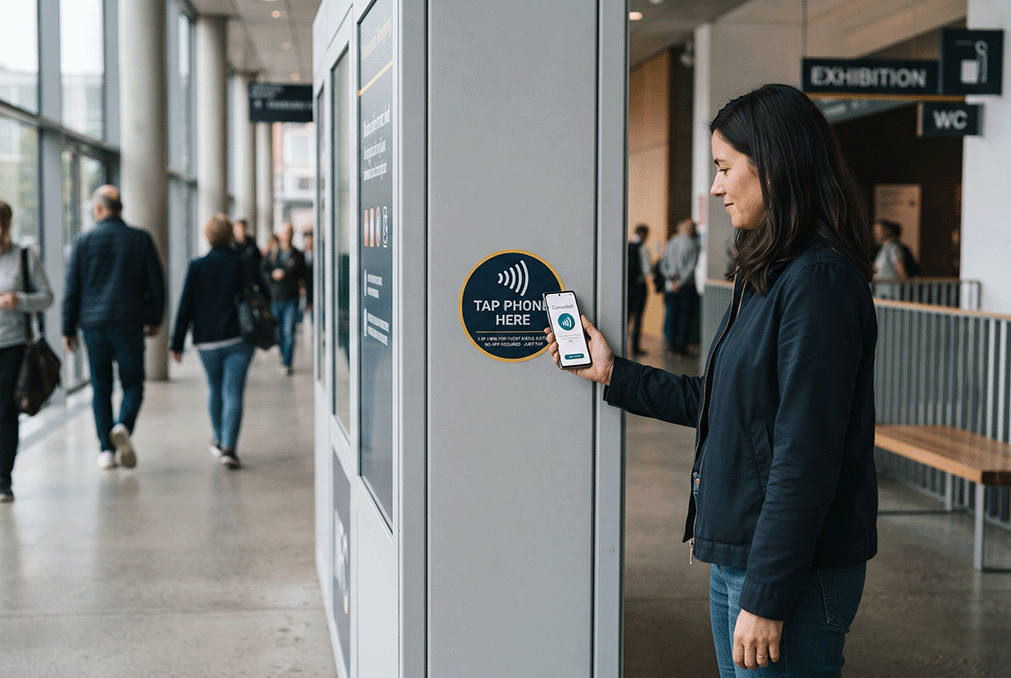
The physical failure is the biggest one. An NFC tag needs a phone within a centimetre or two. A poster mounted behind glass in a bus shelter, framed in an aluminium surround, positioned above head height, or sited where a person would have to step into a road to reach it, will never be tapped by anyone — and this describes a large fraction of the poster estate. Place the tag between waist and shoulder height, on a surface an adult can reach without leaning, without a barrier in front of it, and mark it with a symbol and a short instruction in the local language, because most people have never knowingly tapped a poster. Aluminium frames and metal panels behind the paper require an on-metal construction, or the tag will not read even when reached. And in a bus shelter, the tap point should not be where a person's back rests. Understanding that placement, height, reach, and the material behind the paper determine whether the tag exists at all is the least glamorous and most decisive part of the job.
Give the tag a reason to be, in each place
The same poster in two places is two campaigns. A poster outside a venue can offer directions and today's opening hours; the identical poster three miles away cannot, and should offer a route and a booking. A tag beside a restaurant can offer the menu; the same design at a station can offer the delivery link. Because the tag carries a site-specific link, this costs nothing but planning, and it converts an untargeted medium into a contextual one. It also produces the only measurement that matters: taps per poster, per day, which tells you which sites, heights, and dwell contexts work, and which are decoration. Report tap rate by site rather than campaign totals, and be prepared for one site to produce more than the other forty combined. Understanding that a poster tag's payload should differ by location — and that its data will tell you where people actually stand — is what turns a novelty into a media buy you can optimise.
What the tap is honestly worth
Expect small numbers, and measure them properly. A poster tag will be tapped by a low single-digit percentage of the people who pass it, and by a larger share of those who wait beside it. That is not failure; a poster's alternative interaction rate is zero. Compare tap counts against the cost of the tags and their installation, not against digital advertising benchmarks, and value the taps by what they produced — codes redeemed, tickets added to calendars, routes opened. Keep a printed short URL and a code beside the tag, because a large share of the audience will not have an NFC-capable phone in an unlocked state, and that fallback frequently carries more traffic than the tag. Understanding that the tag adds a small, cheap, measurable interaction to a medium that previously had none — and does not replace other channels — is the expectation to set before the campaign, not after it.
Getting started
To get started, choose sites by dwell time rather than footfall: waiting rooms, platforms, queues, lift lobbies. Write the payload to complete within the wait and to work for an anonymous person on a poor connection. Place the tag where an arm reaches, specify on-metal where frames or panels are metallic, and print a fallback code and a one-line instruction. Give each site its own link. Then measure taps per poster per day and what followed. As a manufacturer of NFC tags and printed labels, our team supplies poster tags encoded per site, in constructions tested against the actual frames and panels of your estate. To plan a poster campaign, contact our team.
Frequently Asked Questions
What makes a poster tap different from tapping a product?
The person. She is a stranger with no relationship to the brand, no reason to trust the page, and no patience for one. She is not holding something she bought, not in a shop she chose, and not completing a task she wanted. She is waiting at a bus stop or on a platform with ninety seconds to spare. Almost every failed poster deployment was designed for a different person — a loyal customer with time — and the design must instead follow from that ninety seconds of borrowed attention.
What should the poster page offer?
Something that completes inside the wait: a discount code that will still exist when she reaches the shop, a route or timetable, a one-tap add-to-calendar with the location filled in, an audio track she can start now and finish on the train, or a plain text answer to exactly what the poster promised. Not a video, a form, a catalogue, or an app install. The test is whether she can leave better off than she arrived, without giving anything up, before her bus comes.
Should a poster tag ask for an email address?
Not before it has delivered something. Every request costs a stranger who has nothing invested: an email field, a login, a full-screen cookie consent, an app install, or a permission prompt each ends a meaningful share of interactions that were going well. A poster tap must be useful without identifying the person. If identity is genuinely needed — to send a ticket or a code — ask afterwards, frame it as a choice, and make sure the page works perfectly for someone who declines everything.
Why do so many poster tags never get tapped?
Because they cannot be reached. NFC needs a phone within a centimetre or two, and much of the poster estate is behind glass in a bus shelter, framed in aluminium, above head height, or sited where a person would step into a road. Place the tag between waist and shoulder height on a reachable surface with no barrier, mark it with a symbol and a short instruction in the local language, and specify an on-metal construction wherever a metal frame or panel sits behind the paper.
How should poster tag performance be measured?
Taps per poster per day, not campaign totals — and then by what the taps produced: codes redeemed, tickets added to calendars, routes opened. Expect a low single-digit percentage of passers-by and a higher share of those who wait beside it; a poster's alternative interaction rate is zero, so compare against tag and installation cost rather than digital advertising benchmarks. Keep a printed short URL and code beside the tag; that fallback often carries more traffic than the tag itself.
Plan a poster tag campaign
We supply poster tags encoded per site, in constructions tested against the actual frames and panels of your estate — with printed fallbacks and clear tap-point marking.
Discuss poster tags See NFC tags