


We will cover what asset tags are, then five applications — IT tracking, fixed-asset audits, tool management, returnable items, and maintenance tracking — followed by how to choose.
Key takeaways
- RFID asset tags identify, locate, and count assets automatically.
- They speed audits, cut losses, and improve equipment utilization.
- Applications span IT, facilities, tools, returnables, and maintenance.
- Tag choice depends on the asset material, environment, and read needs.
What RFID asset tags are
RFID asset tags are tags attached to physical assets, each carrying a unique identifier (and optionally data) that a reader captures wirelessly. Unlike barcodes, they need no line-of-sight and can be read at range and in bulk, so many assets are identified quickly, and unlike manual logs, they update automatically. Tags come in forms suited to different assets — labels, hard tags, anti-metal tags for metal equipment, small tags for tools — and in HF or UHF frequencies for different read needs. Linked to asset-management software, the tags let an organization know what assets it has, where they are, and their status. This automated, wireless identification is the foundation of RFID asset tracking. Understanding that RFID asset tags provide wireless, bulk, no-line-of-sight identification of assets, linked to management software, is the basis for the applications, since this capability is what enables the faster audits, reduced losses, and better visibility that the tags deliver across the asset-tracking uses that follow.
Application 1: IT equipment tracking
The first application is tracking IT equipment — computers, servers, laptops, monitors, network gear, and devices. IT assets are numerous, valuable, mobile, and often metal-housed, making them hard to track manually. RFID tags (anti-metal where needed) on IT assets let organizations maintain an accurate inventory, locate equipment, track moves and assignments, and conduct audits quickly. In data centers, RFID tracks servers and gear across racks; in offices, it tracks devices across locations and users. This reduces lost or misplaced IT assets, supports security and compliance, and speeds the audits IT departments must perform. Given the value and mobility of IT equipment, RFID tracking delivers clear returns. For IT asset management, RFID tags bring automated visibility to numerous, valuable, mobile equipment. Understanding that RFID asset tags enable accurate inventory, location, move tracking, and fast audits of numerous, valuable, often-metal IT equipment shows the first application's value, addressing the challenge of tracking the IT assets that organizations depend on and must account for, which the tags make manageable.
Application 2: Fixed-asset audits
The second application is fixed-asset audits — the periodic physical verification of assets organizations must perform for accounting, compliance, and control. Done manually, audits are slow, labor-intensive, and error-prone, often taking weeks. With RFID tags on assets, an auditor with a reader can verify hundreds of assets rapidly by reading tags in an area, comparing against the asset register automatically. This transforms audits from a lengthy manual chore into a fast, accurate process, and improves data quality by catching discrepancies, missing assets, and unrecorded items. Organizations with large fixed-asset bases — equipment, furniture, machinery across many locations — gain enormous time savings and accuracy. Regular RFID-enabled audits keep asset records current and support financial and compliance requirements. For fixed-asset audits, RFID tags turn a slow manual process into a rapid one. Understanding that RFID asset tags let auditors verify assets rapidly against the register, replacing slow manual counts with fast accurate audits, shows the second application's value, addressing the burdensome audit requirement that the tags dramatically streamline for organizations with substantial asset bases.

Application 3: Tool and equipment management
The third application is managing tools and equipment — tracking check-out and return, location, and availability of tools in tool cribs, workshops, construction sites, and maintenance operations. Tools are easily lost, misplaced, or not returned, costing money and downtime. RFID tags on tools (rugged, often anti-metal for metal tools) let organizations track which tools are out and to whom, ensure return, locate tools, and manage tool inventory. Check-in/out stations read tags automatically, and audits verify the tool set. This reduces tool loss, ensures tools are available when needed, and improves accountability. For operations dependent on tools — manufacturing, maintenance, construction, aviation — RFID tool tracking prevents the losses and downtime missing tools cause. RFID tags bring control to tool and equipment management. Understanding that RFID asset tags enable check-out/return tracking, location, and inventory of tools and equipment, reducing loss and ensuring availability, shows the third application's value, addressing the costly problem of lost and unaccounted tools that the tags solve for tool-dependent operations.
Application 4: Returnable transport items
The fourth application is tracking returnable transport items (RTIs) — reusable containers, pallets, crates, cages, totes, and packaging that cycle through supply chains and must be tracked to control and recover them. RTIs represent significant investment and are often lost or unreturned, costing money to replace. RFID tags on RTIs let organizations track their location and movement, monitor cycles, ensure return, and manage the RTI pool. Readers at facilities and dock portals record RTI movement automatically, and audits count the pool. This reduces RTI loss, improves utilization, and controls the reusable-asset investment. For operations using returnable containers and packaging — logistics, manufacturing, retail supply chains — RFID RTI tracking recovers assets and controls costs. RFID tags bring visibility to the returnable-asset pool. Understanding that RFID asset tags enable location, movement, and cycle tracking of returnable transport items, reducing loss and controlling the reusable-asset investment, shows the fourth application's value, addressing the costly loss of returnable containers and packaging that the tags help operations recover and manage.
Application 5: Maintenance and inspection tracking
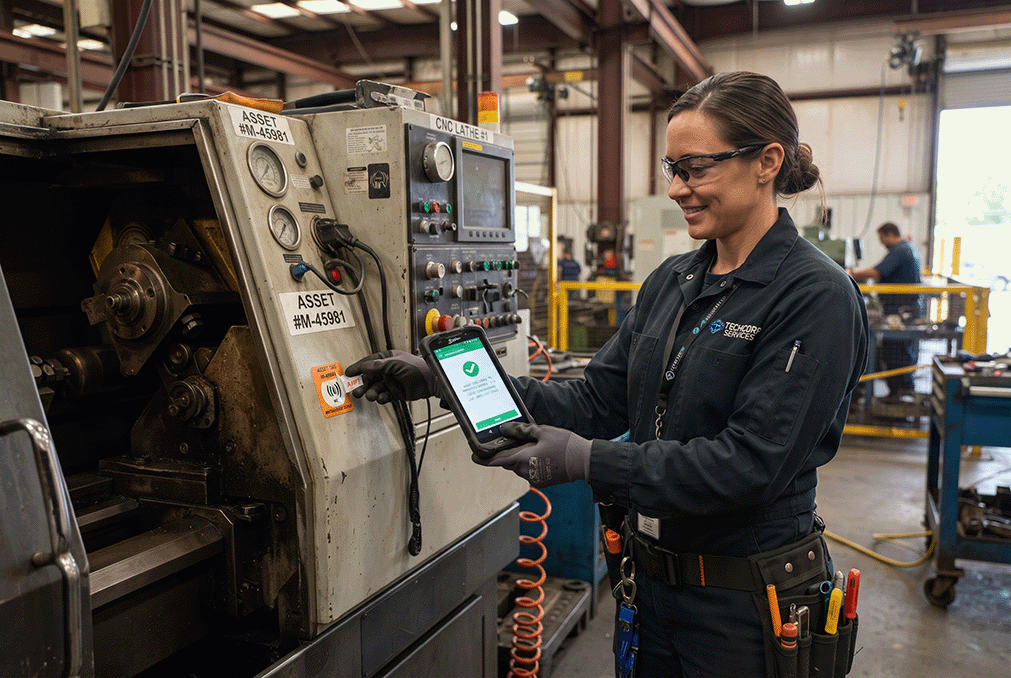
The fifth application is maintenance and inspection tracking — using tags on equipment to manage service, inspection, and compliance records. Many assets require scheduled maintenance or periodic inspection (safety equipment, machinery, fire extinguishers, tools), and tracking this manually is error-prone. An RFID (often NFC) tag on the asset lets a technician tap or scan to identify it, pull up its service history, log completed maintenance or inspection, and confirm the asset was serviced — creating an accurate, auditable record. This ensures maintenance and inspections are performed and recorded, supports compliance and safety, and ties each service to the specific asset. For operations with maintenance or inspection obligations, RFID/NFC tags bring accuracy and accountability to the records. RFID tags turn maintenance and inspection tracking from paper logs into reliable digital records. Understanding that RFID and NFC asset tags enable identification, service-history access, and logging of maintenance and inspections, creating auditable records, shows the fifth application's value, addressing the compliance and reliability needs of maintenance and inspection that the tags support across equipment-intensive operations.
How to choose asset tags that fit
Choosing asset tags for these applications depends on the assets and environment. Consider the asset material — metal assets need anti-metal tags, non-metal assets take standard tags. Choose the frequency — UHF for range and bulk reading (audits, RTIs, warehouses), HF/NFC for close item-level reads and maintenance tapping. Match the form factor to the asset — labels for flat surfaces, hard tags for rugged assets, small tags for tools, durable tags for harsh environments. Ensure durability suits the conditions. Confirm chip and software compatibility. Because assets and environments vary, testing tags on your assets is wise. Working through material, frequency, form, durability, and compatibility ensures the tags fit. As a manufacturer of RFID asset tags — including anti-metal tags for metal assets — our team can help you select tags for IT, tools, returnables, or maintenance tracking. To get RFID asset tags suited to your assets and applications, contact our team with your asset types, environment, and read requirements.
Frequently Asked Questions
What can RFID asset tags track?
Almost any physical asset — IT equipment (computers, servers, network gear), fixed assets (machinery, furniture, equipment), tools, returnable transport items (containers, pallets, cages), and assets requiring maintenance or inspection. The tags provide wireless, bulk, no-line-of-sight identification linked to management software, so an organization knows what assets it has, where they are, and their status, across many asset types and applications.
How do RFID asset tags speed audits?
By letting an auditor with a reader verify many assets rapidly. Instead of manually finding and checking each asset (slow, weeks-long, error-prone), the auditor reads the tags in an area and the system compares them against the asset register automatically, verifying hundreds of assets in minutes and catching discrepancies. This turns fixed-asset audits from a lengthy manual chore into a fast, accurate process, saving substantial time.
Do asset tags work on metal equipment?
Yes, with anti-metal tags. Ordinary RFID tags fail on metal because metal reflects and detunes the signal, but anti-metal asset tags use an isolation layer so they read reliably on metal-housed IT equipment, metal tools, machinery, and metal containers. Since much valuable equipment is metal, anti-metal tags are essential for tracking those assets — choose anti-metal versions for any metal assets in your deployment.
How do RFID tags help with maintenance tracking?
An RFID or NFC tag on equipment lets a technician tap or scan to identify the asset, view its service history, log completed maintenance or inspection, and confirm servicing — creating an accurate, auditable record tied to the specific asset. This ensures scheduled maintenance and periodic inspections (of machinery, safety equipment, tools) are performed and recorded, supporting compliance and safety far more reliably than paper logs.
How do I choose the right asset tags?
Match them to your assets and environment: anti-metal tags for metal assets, standard tags otherwise; UHF for range and bulk reading (audits, returnables, warehouses) or HF/NFC for close item-level reads and maintenance tapping; a form factor suited to the asset (labels, hard tags, small tool tags); durability for the conditions; and chip/software compatibility. Testing tags on your actual assets is wise before ordering in quantity.
Get RFID asset tags for your operation
We manufacture RFID asset tags — standard and anti-metal, UHF and HF/NFC — for IT equipment, tools, returnable containers, and maintenance tracking across your assets.
Discuss asset tags Explore RFID tags