


We will cover measuring the baseline, piloting on a few tables, writing the ask, briefing staff, handling negative reviews, and scaling.
Key takeaways
- Record your current review rate before deploying anything.
- Pilot on a handful of tables, not the whole estate.
- Ask neutrally, send everyone to the same page, offer nothing in exchange.
- Plan how you will respond to the negative reviews that will now arrive.
Measure the baseline first
Measure the baseline before anything else, because without it every later claim is guesswork. Record, for the last three to six months, how many reviews your venue received per month, their average rating, and their distribution — not just the mean, which hides everything, but how many ones and how many fives. Note the seasonality if you have it. If you have several sites, record each separately, because they differ more than you expect. This takes an hour and gives you the only thing that can later tell you whether the stands changed anything: a before. Do it even if you are certain the stands will help, and especially if the decision to buy them has already been made — a pilot that cannot fail teaches you nothing. Understanding that a recorded pre-deployment baseline of review volume, average rating, and rating distribution per site is the only way to evaluate review stands afterwards, is the step that makes the whole project measurable rather than merely hopeful.
Pilot on a handful of tables
Pilot small. Take one site, and within it a defined subset — say five or ten tables, or one counter position — and place stands only there. Leave the rest of the venue as it was, which gives you an internal comparison in the same weeks, under the same weather, with the same staff and menu. Run it for long enough to gather meaningful numbers, which for most venues means several weeks rather than days. Count taps (your links tell you) alongside reviews received, because the gap between them is itself informative: many taps and few reviews means the review page or the platform's sign-in is losing people; few taps means the stand, prompt, or placement is failing. Move a stand mid-pilot and see what changes. Understanding that a small pilot with an unstanded control area — measured on both taps and resulting reviews — separates a placement problem from a page problem, is how a business learns something from its first stands instead of merely buying them.

Write the ask before you print
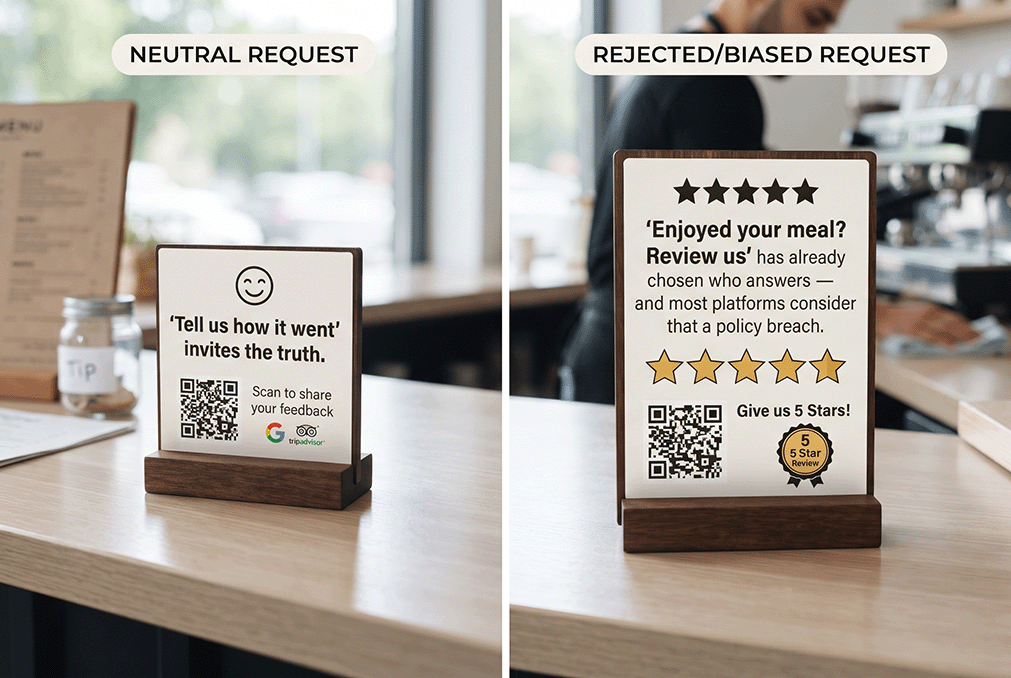
Write the ask before any artwork exists, because the words on the stand do most of the work and the wrong words break the rules. Ask neutrally: "Tell us how it went" or "Leave a review" — never "Leave us five stars," never "Enjoyed your meal? Review us," which pre-selects the happy. Say concretely what a tap will do, mark the tap point with the NFC symbol, and make the stand legible at the distance a seated customer views it. Offer nothing in exchange: no discount, no free drink, no prize draw, because the major review platforms prohibit incentivized reviews and the penalties reach the loss of a listing. And send every customer who taps to the same page, whatever they intend to write — routing by sentiment is review gating, which is dishonest and against platform policy. Understanding that the ask must be neutral, concrete, incentive-free, and identical for every customer — because gating and incentives breach platform rules — is the constraint that shapes an honest review stand.
Brief staff on what not to do
Brief staff primarily on prohibitions, because their instincts will otherwise create problems. Tell them what the stand is and how a tap works, so they can answer a question. Give them one natural sentence they may offer when the moment fits. Then be explicit: they must not pressure anyone, must not offer anything in exchange, must not ask only the customers they judge to be happy, must not tap the stand themselves or review from a business device, and must not stand over a customer while they write. Explain why — that a rating built on selection is worthless and can cost the business its listing — rather than issuing rules without reasons, since staff who understand will comply when unsupervised. Give them a way to report a damaged or missing stand. Understanding that staff must be briefed on what they must not do — no pressure, no incentives, no selecting who is asked, no reviews from business devices — protects a venue from breaching platform policy through well-meaning enthusiasm.
Plan for the negative reviews you will now receive
Negative reviews will arrive, and a venue that has not planned for them will panic and do something foolish. This is the predictable consequence of asking everyone rather than only the delighted: your rating may dip before it stabilizes, and the distribution will widen. That is not a failure — it is your actual service becoming visible. Decide beforehand who reads new reviews, how quickly they respond, and what a good response looks like: acknowledge the specific complaint, do not argue, do not accuse the reviewer of lying, offer to fix it privately, and never reveal a customer's details in a public reply. Route recurring complaints to whoever can act on them. A venue that responds well to criticism often gains more trust from prospective customers than a flawless rating would have earned. Understanding that honest solicitation widens the rating distribution — and that a planned, non-defensive response process turns criticism into trust — is what a review stand pilot must prepare for.
Deciding success, then scaling
Define success numerically before the pilot ends: a target review volume per month per site, measured against the baseline; a target tap-to-review conversion; a stable or improving distribution once it settles. Then judge honestly. If taps are high and reviews low, fix the page or the platform sign-in, not the stand. If taps are low, move the stand, rewrite the prompt, or check the tag reads on the table surface — metal tables need an on-metal construction. If both are healthy, scale: order stands for the estate, with constructions suited to each surface, encoded with per-site links so you can compare venues, printed with the tested prompt, and packed per location. As a manufacturer of NFC tags and stickers, our team can print, encode, and deliver review stands at volume with samples for your pilot. To start, contact our team.
Frequently Asked Questions
Why measure reviews before deploying stands?
Because without a baseline every later claim is guesswork — reviews went up a bit, or they did not, and the season changed and a competitor closed. Record, for the last three to six months, how many reviews each site received per month, the average rating, and the distribution (how many ones and how many fives, not just the mean, which hides everything). Note seasonality. It takes an hour and gives you the only thing that can later show whether the stands changed anything. Do it even if the purchase is already decided; a pilot that cannot fail teaches nothing.
How big should the first deployment be?
Small. Take one site and a defined subset — five or ten tables, or one counter position — and place stands only there, leaving the rest as it was so you have an internal comparison in the same weeks, with the same staff and menu. Run it for several weeks, not days. Count taps alongside reviews received, because the gap is informative: many taps and few reviews means the review page or platform sign-in is losing people; few taps means the stand, prompt, or placement is failing. Move a stand mid-pilot and see what changes.
What should the stand actually say?
Ask neutrally — 'Tell us how it went' or 'Leave a review' — never 'Leave us five stars' or 'Enjoyed your meal? Review us,' which pre-selects the happy. Say concretely what a tap will do, mark the tap point with the NFC symbol, and make the stand legible from where a seated customer sits. Offer nothing in exchange: no discount, free drink, or prize draw, because the major platforms prohibit incentivized reviews and penalties reach the loss of a listing. And send every customer who taps to the same page, whatever they intend to write.
What do staff need to be told?
Mostly what not to do. Explain what the stand is and how a tap works so they can answer questions, and give them one natural sentence to offer when the moment fits. Then be explicit: no pressuring anyone, nothing offered in exchange, no asking only the customers they judge to be happy, no tapping the stand themselves or reviewing from a business device, and no standing over a customer while they write. Explain why — a rating built on selection is worthless and can cost the listing — so they comply when unsupervised. Give them a way to report damaged stands.
What happens to our rating when we ask everyone?
The distribution widens and the rating may dip before it stabilizes, because your actual service is becoming visible rather than a filtered version of it. Plan for that: decide who reads new reviews, how quickly they respond, and what a good response looks like — acknowledge the specific complaint, do not argue, never accuse the reviewer of lying, offer to fix it privately, and never reveal a customer's details in a public reply. Route recurring complaints to whoever can act. Venues that respond well to criticism often gain more trust than a flawless rating would earn.
Start an NFC review stand pilot
We print, encode, and deliver NFC review stands at volume — per-site links so you can compare venues, on-metal constructions for metal tables, and samples for your pilot tables.
Discuss review stands See NFC tags