


We will cover eavesdropping, unauthorized reading, cloning, relay attacks, and tracking concerns, then the mitigations: encryption, authentication, shielding, read-range control, and secure chips.
Key takeaways
- RFID risks include eavesdropping, unauthorized reading, cloning, and relay attacks.
- The severity depends on frequency, range, and the application's sensitivity.
- Encryption, authentication, and secure chips mitigate the main risks.
- Match the security level to the application — not every use needs the same protection.
Eavesdropping on communications
Eavesdropping is the risk that someone intercepts the communication between a tag and a reader, capturing the data exchanged. Because RFID uses radio waves, in principle a third party with suitable equipment could attempt to listen to the exchange. The practical risk depends heavily on the frequency and range: short-range systems like HF and NFC are harder to eavesdrop on from a distance because the communication range is very limited, while longer-range UHF communications travel farther. For sensitive data, eavesdropping is a concern to address. The mitigation is encryption — if the communication is encrypted, intercepted data is unintelligible to an eavesdropper. Understanding that eavesdropping is possible in principle but limited by range and countered by encryption helps you assess and address it, where for sensitive applications, encrypting the communication ensures that even if a signal is intercepted, the data remains protected, neutralizing the eavesdropping risk for the data that matters.
Unauthorized reading (skimming)
Unauthorized reading, or skimming, is the risk that someone reads a tag without authorization using their own reader, potentially capturing the tag's data. This is a concern for tags carrying sensitive information, such as payment or identity cards, where unauthorized reading could expose data. As with eavesdropping, the risk depends on range — short-range tags require close proximity to read, limiting skimming, while longer-range tags can be read from farther away. Mitigations include short-range operation, authentication so tags only respond to authorized readers, encryption protecting the data, and shielding to block unwanted reading. For sensitive cards, these measures prevent unauthorized reading from exposing data. Understanding that skimming is countered by short range, authentication, encryption, and shielding helps protect sensitive tags, where for cards carrying sensitive data, combining these measures ensures the tag does not divulge information to unauthorized readers, addressing the skimming risk that concerns payment and identity applications.
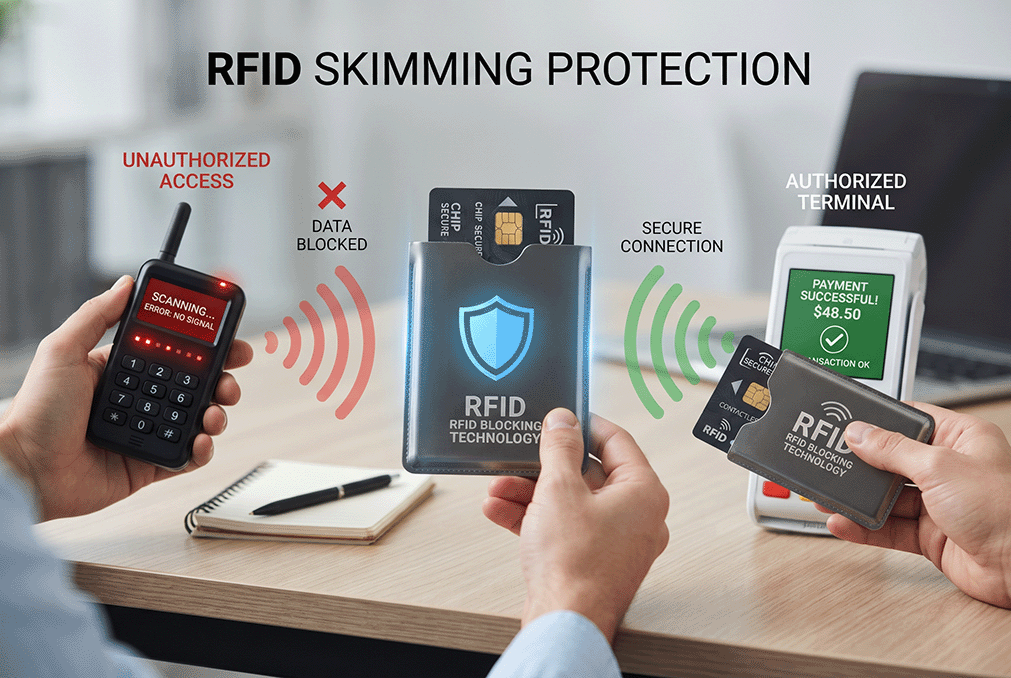
Tag cloning and counterfeiting
Cloning is the risk that someone copies a tag's data to create a duplicate, potentially using the clone to impersonate the original — a concern for access cards or authentication tags where a clone could grant unauthorized access or pass as genuine. Simple tags that merely return a static identifier are more vulnerable to cloning, since copying the identifier suffices. The mitigation is using secure tags with cryptographic authentication, where the tag proves its authenticity through a cryptographic process that cannot simply be copied, making cloning infeasible. Secure chips designed for access and authentication incorporate such protection. For applications where cloning would be damaging, choosing secure, authenticating tags rather than simple identifier-only tags is essential. Understanding that cloning is countered by cryptographic authentication helps secure access and authentication applications, where selecting secure cards with proper cryptographic protection, rather than easily copied simple tags, prevents cloning from enabling unauthorized access or counterfeiting, addressing a key risk for security-sensitive credentials.
Relay attacks
Relay attacks are a more sophisticated risk where attackers relay the communication between a legitimate tag and reader over a distance, making the system behave as if the tag and reader are close when they are not — potentially defeating proximity-based security. This is a concern for some access and payment systems. Relay attacks are more complex to execute and to defend against, but mitigations exist, including timing constraints that detect the delay a relay introduces, and additional authentication factors. For high-security applications where relay attacks are a realistic threat, systems can incorporate defenses against them. While more advanced than basic risks, relay attacks are addressed in security-conscious system design. Understanding that relay attacks exist and can be mitigated through timing and additional authentication helps high-security applications, where for the most sensitive access systems, incorporating relay-attack defenses ensures that proximity-based security cannot be defeated by relaying communications, addressing a sophisticated threat where warranted.
Tracking and privacy concerns
Tracking is a privacy concern that arises if tags with unique identifiers can be read by others, potentially allowing the tracking of items or, by extension, people carrying them. This concern applies particularly to tags on personal items or cards that could be read to track movements. Mitigations include short-range tags that limit who can read them, the ability to disable tags when no longer needed (such as the kill command in EPC Gen2 that permanently deactivates a tag), data minimization so tags carry only what is necessary, and privacy-conscious system design. For consumer applications, addressing tracking concerns through these measures protects privacy. Understanding that tracking concerns are addressed through short range, tag deactivation, data minimization, and privacy-conscious design helps deploy RFID responsibly, where considering privacy implications and employing appropriate measures ensures that RFID does not enable unwanted tracking, addressing a legitimate concern especially for consumer-facing and personal applications.
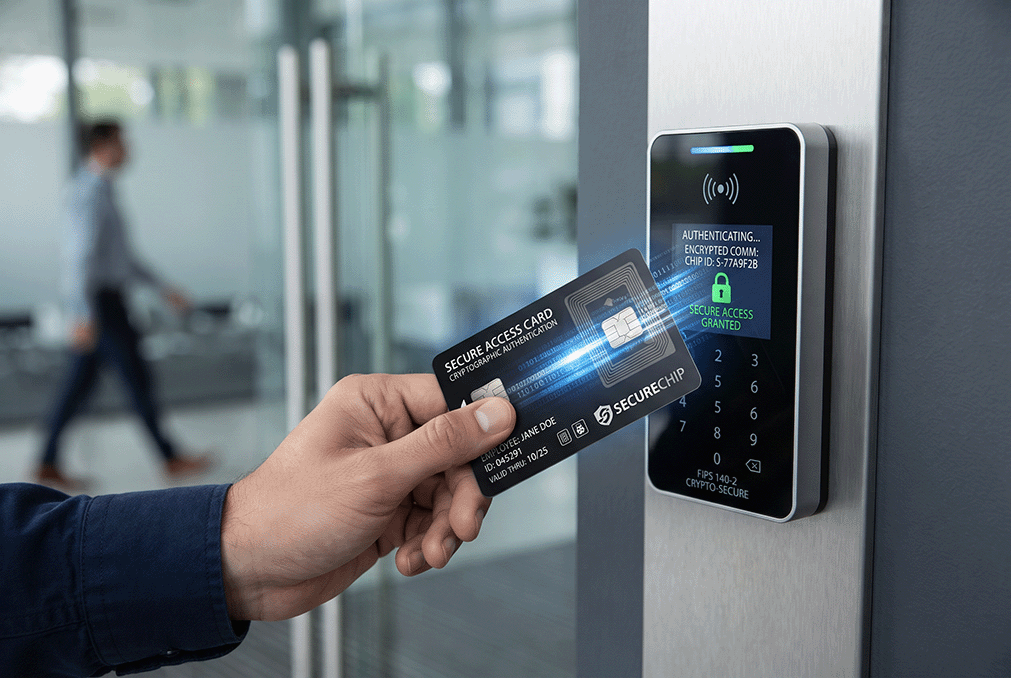
Key mitigations: encryption and authentication
Encryption and authentication are the cornerstones of RFID security. Encryption protects data so that intercepted communications or read data are unintelligible without the key, countering eavesdropping and protecting sensitive information. Authentication ensures that tags and readers verify each other's legitimacy — tags respond only to authorized readers, and readers trust only genuine tags — countering skimming, cloning, and impersonation. Together, encryption and authentication address the core risks for sensitive applications, and secure RFID chips designed for access, payment, and authentication incorporate these protections. Choosing chips and systems with appropriate cryptographic security is the foundation of securing sensitive RFID deployments. Understanding that encryption and authentication, implemented in secure chips, counter the main risks helps you secure sensitive applications, where selecting secure cards and systems with proper encryption and authentication provides the protection that access control, payments, and authentication require, forming the security foundation on which sensitive RFID applications are built.
Matching security to the application
The right security level depends on the application, since not every use needs the same protection. A simple inventory tag on a carton needs little security, while an access card, payment card, or authentication tag needs robust protection. Over-securing a low-risk application wastes resources, while under-securing a sensitive one creates risk. The key is matching the security measures — chip choice, encryption, authentication, shielding — to the application's actual sensitivity and threat model. Assessing what data is involved, what an attacker could gain, and what protection is warranted guides appropriate security. As a manufacturer offering RFID products across security levels, from simple tags to secure authenticating chips, our team helps customers choose the right security for their application. To select RFID products with security appropriate to your application, contact our team, and explore our range from standard tags to secure cards for sensitive uses.
Frequently Asked Questions
What are the main RFID security risks?
The main risks are eavesdropping (intercepting tag-reader communication), unauthorized reading or skimming (reading tags without authorization), cloning (copying a tag to create a duplicate), relay attacks (relaying communication to defeat proximity security), and tracking (using tag identifiers to track items or people).
How can RFID communications be protected?
Encryption protects data so that intercepted communications are unintelligible without the key, while authentication ensures tags respond only to authorized readers and readers trust only genuine tags. Together, implemented in secure chips, they counter eavesdropping, skimming, and cloning for sensitive applications.
Can RFID access cards be cloned?
Simple tags that return a static identifier are vulnerable to cloning, but secure cards with cryptographic authentication prove their authenticity through a process that cannot simply be copied, making cloning infeasible. For access control, choosing secure authenticating cards rather than simple identifier-only tags prevents cloning.
Does RFID pose privacy risks?
Tracking is a privacy concern if tags with unique identifiers can be read by others to track items or people carrying them. This is mitigated through short-range tags, the ability to deactivate tags (such as the EPC Gen2 kill command), data minimization, and privacy-conscious system design.
Does every RFID application need strong security?
No. The right security level depends on the application. A simple inventory tag needs little security, while an access card, payment card, or authentication tag needs robust protection. The key is matching security measures to the application's actual sensitivity and threat model rather than over- or under-securing.
Secure your RFID application appropriately
We offer RFID products across security levels — from simple inventory tags to secure cards with cryptographic authentication — helping you match protection to your application's real needs.
Discuss your security needs Explore secure RFID cards